
Super Typhoon Sinlaku: The Pacific Faces 2026’s Most Powerful Storm
A Monster Storm Bears Down on U.S. Territories
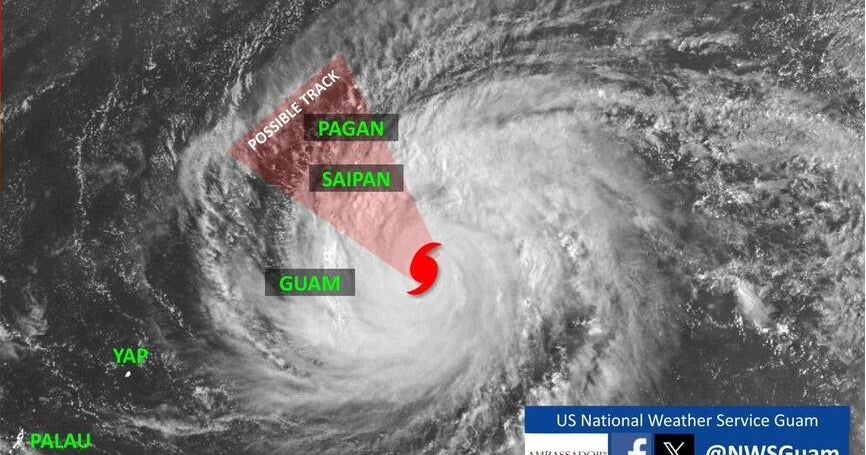
The western Pacific is holding its breath as Super Typhoon Sinlaku, the most powerful storm of 2026, barrels toward Guam and other U.S. island territories in the Marianas chain. With maximum sustained winds reaching a staggering 175 miles per hour—after peaking at 180 mph just a day earlier—this massive weather system represents a serious threat to the thousands of residents and military personnel stationed across these remote islands. The storm’s approach has triggered a cascade of warnings and watches across the region, prompting emergency preparations and sending people scrambling to secure their homes and loved ones against what could be a devastating natural disaster.
The Marianas Islands, an archipelago of 15 islands stretching across the western Pacific about 1,500 miles east of the Philippines, rarely make headlines in mainland America. However, these U.S. territories are home to significant populations and strategic military installations, including three major bases on Guam. As Sinlaku continues its relentless march west-northwest, the eyes of meteorologists, military commanders, and anxious family members across the Pacific rim remain fixed on satellite imagery showing the storm’s swirling mass approaching these vulnerable island communities. The National Weather Service office in Guam has been working around the clock to provide updates and guidance to residents, many of whom have lived through typhoons before but recognize that Sinlaku represents something exceptional—a once-in-a-generation storm that demands respect and preparation.
Understanding the Beast: What Makes a Super Typhoon
For those unfamiliar with Pacific weather patterns, it’s important to understand that a typhoon is essentially the same meteorological phenomenon as a hurricane—just a different name used in different parts of the world. While Americans living along the Atlantic and Gulf coasts brace for hurricanes, their fellow citizens in the Pacific territories face typhoons, which can be equally destructive and deadly. The naming convention changes based on geography, but the science remains the same: these are massive rotating storm systems fueled by warm ocean waters that can generate catastrophic winds, torrential rains, and life-threatening storm surges.
In the Atlantic, meteorologists classify hurricanes on the Saffir-Simpson scale, ranging from Category 1 (the weakest) to Category 5 (the most devastating). Any storm with sustained winds of 157 mph or greater earns that feared Category 5 designation. In the Pacific, storms of this intensity are called “super typhoons,” a term that captures both the scientific classification and the visceral dread these monsters inspire. Sinlaku easily qualifies for this designation, with winds that at their peak reached 180 mph—well into territory that can level buildings, strip trees bare, turn everyday objects into deadly projectiles, and fundamentally alter the landscape of any island unfortunate enough to experience a direct hit.
What makes Sinlaku particularly noteworthy is its status as the strongest storm of 2026 thus far, surpassing two earlier typhoons—Narelle and Dudzai—which peaked at 149 and 147 mph respectively. According to CBS News meteorologist Nikki Nolan, this distinction places Sinlaku in an elite and terrifying category of storms that meteorologists track with particular concern. The storm’s wind field is enormous, with typhoon-force winds extending outward up to 80 miles from its center and tropical-storm-force winds reaching out an astonishing 275 miles. This means that even islands not directly in the storm’s path will feel its effects, potentially for days as the massive system slowly moves through the region.
Islands in the Crosshairs: Who’s at Greatest Risk
As Monday turned to Tuesday in the Marianas, the National Weather Service had issued a complex array of warnings and watches tailored to each island’s specific level of risk. The neighboring islands of Tinian and Saipan, along with Rota, were under typhoon warnings—the most serious alert, indicating that typhoon conditions were expected within the warning area. These islands appeared to be directly in Sinlaku’s forecasted path, meaning residents there faced the very real possibility of experiencing the storm’s most violent winds and heaviest rainfall. For people living in these communities, the warning meant the time for preparation had essentially passed; now was the time to shelter in place and ride out the storm.
Guam, despite being the largest and most populated island in the Marianas and home to significant U.S. military infrastructure, was initially under a tropical storm warning rather than a typhoon warning, along with the islands of Pagan and Alamagan. This meant that while Guam was expected to experience dangerous conditions, current forecasts suggested the island might be spared the absolute worst of Sinlaku’s fury. However, a typhoon watch remained in effect for Guam, indicating that conditions could still deteriorate to typhoon strength depending on the storm’s exact track. The island of Agrihan was under a tropical storm watch, suggesting it was on the periphery of the storm’s projected path but could still experience hazardous weather.
Officials on Guam were taking no chances despite the somewhat less dire forecast for their island. The Joint Information Center issued advisories urging residents to remain indoors and stay out of the water, acknowledging that while “the threat of typhoon-force winds has significantly diminished, this remains a serious weather event.” The concern centered on the potential for extended exposure to tropical-storm-force winds ranging from 39 to 73 mph, which, while less destructive than typhoon-force winds, can still cause significant damage if sustained over many hours. The forecast window for these conditions stretched from Monday night through Wednesday, meaning residents might need to shelter for days while Sinlaku’s outer bands lashed the island with wind and rain.
Preparing for Impact: A Race Against Time
In the hours leading up to Sinlaku’s arrival, scenes of preparation were playing out across the threatened islands. Residents who have lived through previous typhoons know the drill: secure outdoor furniture and equipment, stock up on non-perishable food and water, charge electronic devices while power is still available, fill bathtubs with water for sanitation if water systems fail, and identify the strongest room in the house for shelter during the worst of the storm. Hardware stores and supermarkets typically see a last-minute rush as people purchase plywood, batteries, candles, and other emergency supplies. For those in the most vulnerable structures, evacuation to designated shelters often becomes necessary, though the COVID-era has complicated this traditional response by requiring social distancing measures that reduce shelter capacity.
The U.S. military installations on Guam faced their own unique challenges in preparing for Sinlaku. Aircraft might need to be relocated to safer locations, ships could put to sea to ride out the storm away from harbor (a practice called “sortie”), and personnel might need to secure sensitive equipment and hunker down in hardened facilities. The military has extensive experience with typhoon preparation in the Pacific, but each major storm tests these procedures and the resilience of infrastructure that, despite being built to higher standards than civilian structures, can still sustain damage from the most powerful systems. The strategic importance of these bases means that recovery efforts would be a high priority in the storm’s aftermath, but the immediate concern was protecting the thousands of service members and their families who call these installations home.
Beyond the immediate human concerns, there was the environmental and infrastructure impact to consider. The Marianas islands, like many Pacific territories, have ecosystems particularly vulnerable to the destructive power of super typhoons. Coral reefs can be damaged by storm surge and sediment, native forests can be stripped of foliage and topsoil, and the freshwater lenses that provide drinking water for some islands can be contaminated by saltwater intrusion. Infrastructure—roads, bridges, power lines, water systems—built on small islands has limited redundancy, meaning damage to key facilities can leave entire communities isolated and without essential services for extended periods. The economic impact on these territories, which have limited resources and depend heavily on federal assistance for disaster recovery, can be profound and long-lasting.
The Science of Prediction: Reading Sinlaku’s Future
One of the few silver linings in the otherwise grim forecast was that Sinlaku was expected to weaken before making its closest approach to the island chain. Meteorologists predicted the storm would lose some intensity as it moved across the Marianas, though they cautioned that even a weakened Sinlaku could still pack winds equivalent to a Category 4 or 5 hurricane—still extraordinarily dangerous and destructive. The weakening forecast likely resulted from several possible factors: interaction with land masses, changes in ocean temperatures, increasing wind shear, or the natural fluctuations that even the most powerful typhoons experience as they evolve. However, forecasting the exact intensity of a typhoon is an imperfect science, and residents were warned not to become complacent based on predictions of weakening.
Modern weather forecasting has made remarkable strides in predicting the path and intensity of tropical cyclones, but significant uncertainty remains, especially regarding rapid intensification or weakening. Satellites provide detailed imagery of storm structure, reconnaissance aircraft fly directly into typhoons to gather data, sophisticated computer models process vast amounts of atmospheric and oceanic information, and meteorologists synthesize all this information to produce forecasts. Despite these tools, small changes in a storm’s environment or internal dynamics can produce outcomes different from predictions. This is why weather services issue warnings and watches covering broad areas and time windows—better to over-warn and have people prepared than to under-warn and leave them vulnerable.
The forecast for Sinlaku included not just strong winds but also the threat of heavy rainfall and flooding, potentially even more dangerous than the wind itself. Typhoons can drop enormous amounts of rain in short periods, and on mountainous islands like those in the Marianas, this can trigger flash flooding and mudslides that catch people by surprise. Saturated soil loses its ability to anchor trees and vegetation, making windthrow more likely and increasing debris that can damage structures or block roads. Coastal areas faced the additional threat of storm surge—the dome of elevated water pushed ahead of the storm that can inundate low-lying areas and cause catastrophic damage. The combination of all these hazards meant that residents across the Marianas needed to prepare for a multi-faceted disaster, not just a windstorm.
A Community Tested: Resilience in the Face of Nature’s Fury
As Sinlaku approached, the people of the Marianas drew on reserves of resilience built through generations of living in one of the world’s most typhoon-prone regions. Island communities develop a particular kind of toughness, born from the knowledge that they cannot simply evacuate to safer ground hundreds of miles away. When a major storm approaches, islanders must stand and face it, relying on preparation, sound structures, community bonds, and a measure of luck to see them through. In the hours before impact, neighbors check on each other, families gather together, and emergency responders position themselves to respond as soon as conditions permit. There’s often a quiet determination mixed with understandable anxiety—a recognition that while much can be done to prepare, ultimately they must weather whatever Sinlaku brings.
The aftermath of a super typhoon can be as challenging as the storm itself. Communication systems often fail, leaving families unable to check on loved ones for days. Power outages can last weeks or even months, particularly on smaller islands with limited utility infrastructure. Access to clean water may be disrupted, food supplies depleted, and medical facilities damaged. The psychological toll of experiencing such a powerful natural disaster and then facing the grinding work of recovery should not be underestimated. Yet history shows that these communities have endured before and will endure again, drawing on both their own resources and assistance from the broader United States to rebuild and recover. As Super Typhoon Sinlaku bore down on these small islands in the vast Pacific, thousands of people hunkered down, hoped for the best, and prepared to show once again the resilience that defines life in this beautiful but challenging corner of America.