


A Soldier’s Heartbreak: Military Wife Detained in Immigration Crackdown
When Love Meets the Law on a Louisiana Military Base
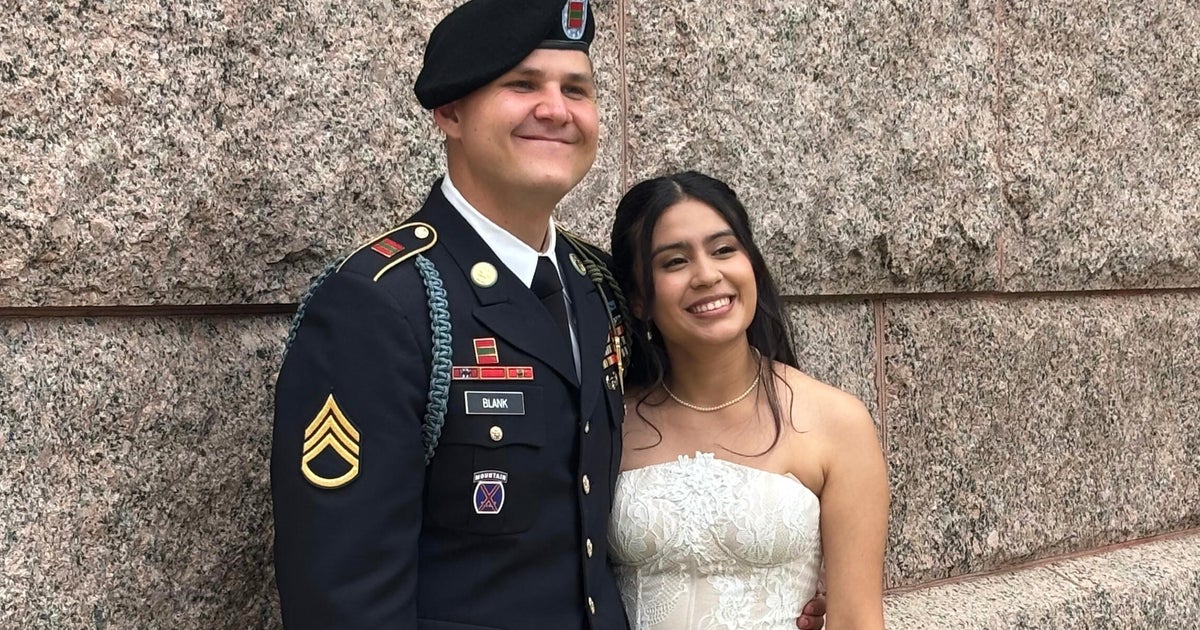
In what should have been one of the happiest moments of their lives, U.S. Army Staff Sergeant Matthew Blank and his newlywed wife Annie Ramos found themselves torn apart by an immigration system that once showed leniency to military families but now operates with strict enforcement regardless of circumstances. The 23-year-old soldier brought his 22-year-old wife to Fort Polk, Louisiana, last Thursday with straightforward intentions: to help her obtain a military ID, activate her spouse benefits, and begin the journey toward securing a green card. They had married just weeks earlier in March, full of hope and plans for their future together. Instead of filling out paperwork and moving into their new home on base, Ramos was detained by federal immigration agents and placed in a detention center, where she remained as of Monday. The young couple’s story has sparked outrage among military family advocates who warn that such actions send a devastating message to service members and could seriously damage military recruitment efforts at a time when the nation can least afford it.
A Life Built in America, Now Hanging in the Balance
Annie Ramos has lived virtually her entire life in the United States. She arrived in this country in 2005 when she was younger than two years old, brought by her family seeking a better life. Her story mirrors that of thousands of other children who grew up American in every way except on paper. As a Sunday school teacher and biochemistry major, Ramos built a life grounded in faith, education, and community service. According to the Department of Homeland Security, her family failed to appear for an immigration hearing in 2005, resulting in a judge issuing a final order of removal. In 2020, hoping to secure her status in the only country she’s ever really known, Ramos applied for Deferred Action for Childhood Arrivals (DACA), the Obama-era program designed to protect people exactly like her—those who were brought to the United States as children through no choice of their own. However, her husband says that application has remained “in limbo” as legal battles over the program’s future continue to play out in courts across the nation. Her mother-in-law, Jen Rickling, described Annie as everything she could have hoped for in a daughter-in-law, someone who “loves my son with her whole heart” and whom the family absolutely adores.
The Policy Shift That Changed Everything for Military Families
The detention of military spouses like Annie Ramos represents a dramatic departure from how the United States government previously handled immigration cases involving immediate family members of active-duty service members. Until recently, the Department of Homeland Security maintained policies that treated military service as a significant mitigating factor when deciding whether to pursue immigration enforcement actions. Last April, however, the Trump administration eliminated a 2022 policy that specifically considered military service of an immediate family member as grounds for leniency. The new policy makes the administration’s position crystal clear: “military service alone does not exempt aliens from the consequences of violating U.S. immigration laws.” This represents a fundamental shift in how the government balances immigration enforcement with support for military families. Prior to this change, DHS generally allowed spouses of active-duty military members to gain legal status through programs like parole in place and deferred action—programs that military recruiters themselves promoted as benefits of service. Now, as DHS bluntly stated regarding Ramos’s case, “She has no legal status to be in this country. This administration is not going to ignore the rule of law.” The message is unmistakable: there are no exceptions, even for those married to soldiers defending the nation.
Expert Warnings About Morale, Readiness, and National Security
Military immigration law expert Margaret Stock has raised serious concerns about the implications of this new enforcement approach. Stock argues that cases like Ramos’s would have been straightforward to resolve under previous administrations but now DHS appears to be actively focusing on detaining members of military families whenever opportunities arise—including, ironically, when those individuals are attempting to follow proper legal procedures to obtain status. “It doesn’t make any sense – they’re going to get arrested for following the law? That’s stupid,” Stock said, adding that “It’s bad for morale, it disrupts the soldiers’ readiness.” The concern extends well beyond individual families to questions of military effectiveness and national security. Lydiah Owiti-Otienoh, who runs the Foreign-Born Military Spouse Network, an advocacy organization, reports seeing an anecdotal increase in cases where military families have been devastated by tightening immigration restrictions. She believes the federal government is fundamentally undermining its own interests by attempting to deport military spouses. “It just sends a really bad message – we don’t care about you, about your spouses, anything you are doing,” Owiti-Otienoh explained. “If military families are not stable, national security is not stable.” More than 60 members of Congress echoed these concerns in a September letter to DHS and the Department of Defense, warning that arrests of military personnel and veterans’ family members represented a betrayal of promises made to service members who play vital roles in protecting national security.
A Soldier’s Plea and a Family’s Pain
Staff Sergeant Matthew Blank’s anguish is palpable in his public statements about his wife’s detention. “I never imagined that trying to do the right thing would lead to her being taken away from me,” he said. “What was supposed to be the happiest week of our lives has turned into one of the hardest.” The young soldier had been excited to build a life with his wife on the military base while serving his country. Their plan was simple and by-the-book: drive to the base, get her military ID at the appropriate office, activate her military spouse benefits, and have her move in after the Easter weekend. Instead, as Blank told The New York Times, “she got ripped away from me.” His mother, Jen Rickling, expressed the family’s bewilderment and pain in a statement to the Associated Press. “I believe in this country,” she said. “And I believe we can do better than this – for Annie, for other military families, and for the values we hold dear.” Blank’s determination remains unshaken despite the emotional devastation: “I want my wife home, and I will not stop fighting until she is back where she belongs, by my side.” His commitment to both his wife and his country puts him in an impossible position—serving a government that has detained the person he loves most.
The Broader Context of Mass Detention and an Uncertain Future
The Ramos case sits within a much larger picture of dramatically expanded immigration enforcement under the Trump administration’s mass deportation agenda. In January, the number of detainees in U.S. Immigration and Customs Enforcement custody reached a record high, surpassing 70,000 for the first time in the deportation agency’s 23-year history, according to internal Department of Homeland Security data. This represents an unprecedented level of immigration detention in American history. Military family advocates worry that the message being sent to service members is clear and damaging: the sacrifices you make for your country do not extend to protection for your family members. Some lawmakers have raised concerns that the administration may be targeting military families using information those families voluntarily provided to the federal government in connection with their service—essentially punishing them for being honest and following proper procedures. The Pentagon declined to comment on the Ramos case or the broader issue. As Annie Ramos remains in detention and her husband continues his service, their case raises fundamental questions about how America treats those who serve and the families who support them. For Matthew Blank, a 23-year-old soldier who thought he was doing everything right, the answer to those questions has brought nothing but heartbreak and a fight he never expected to wage—not against a foreign enemy, but against his own government, to bring his wife home.