
The World’s Oldest Octopus That Never Was: A Scientific Discovery Rewrites Marine History
A Case of Mistaken Identity Spanning Centuries
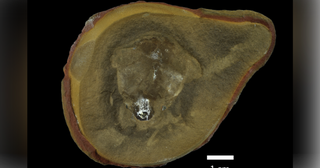
In a remarkable turn of events that highlights both the challenges of paleontology and the importance of revisiting scientific assumptions, researchers have determined that what was long celebrated as the world’s oldest octopus fossil is actually something entirely different. The fossil in question, known scientifically as Pohlsepia mazonensis, has been stripped of its title after new evidence revealed it belonged not to an ancient octopus, but to a completely different type of sea creature—a relative of the nautilus. Thomas Clements, a zoology professor at the University of Reading in England who led this groundbreaking research, put it bluntly: “It turns out the world’s most famous octopus fossil was never an octopus at all.” This discovery, while potentially disappointing to octopus enthusiasts, opens up fascinating new questions about the evolution of ancient marine life and demonstrates how modern technology can help us correct historical misunderstandings about Earth’s prehistoric inhabitants.
The Challenging Nature of Ancient Remains
The fossil at the center of this scientific detective story has been a source of debate among experts for years, and for good reason. According to Clements, who spoke candidly about the difficulties involved in studying Pohlsepia mazonensis, “It’s a very difficult fossil to interpret. To look at it, it kind of just looks like a white mush.” The creature, roughly the size of a human hand, was discovered in the Mazon Creek area of Illinois—a region located about 50 miles southwest of Chicago that has proven to be a treasure trove of fossils from a period that predates the age of dinosaurs. The challenge facing researchers was that this ancient blob did bear a superficial resemblance to modern deep-water octopuses, making it easy to understand why earlier paleontologists might have jumped to conclusions. The ambiguous appearance of the fossil—essentially a flattened, whitish mass embedded in rock—meant that identifying its true nature required looking beyond what was visible on the surface and employing cutting-edge technology that wasn’t available to the scientists who first examined it.
How an Octopus Became a Nautilus
The revelation that this fossil belonged to a nautilus relative rather than an octopus came through the application of sophisticated modern technology. Clements and his research team employed a synchrotron—an advanced scientific instrument that uses fast-moving electrons to generate beams of light brighter than the sun—to peer deep inside the fossil rock. What they discovered was a crucial piece of evidence: a ribbon of teeth known as a radula, a tongue-like organ common to all mollusks, including both nautiluses and octopuses. However, it wasn’t just the presence of the radula that solved the mystery, but rather the specific arrangement of teeth upon it. The team found that each row contained 11 teeth, a number that proved to be the smoking gun in their investigation. Modern octopuses have radulas with either seven or nine teeth per row—never 11. “This has too many teeth, so it can’t be an octopus,” Clements explained with scientific certainty. “And that’s how we realize that the world’s oldest octopus is actually a fossil nautilus, not an octopus.” Further investigation revealed that these teeth perfectly matched those of Paleocadmus pohli, a fossil nautiloid that had previously been found in the same Illinois location, confirming the team’s hypothesis about the creature’s true identity.
The Evolution Puzzle and the Missing Shell
The original misidentification of this fossil as an octopus had significant implications for our understanding of evolutionary history. When paleontologists classified it as an octopus back in 2000, the discovery completely upended existing theories about when eight-tentacled cephalopods first appeared on Earth, suggesting they had emerged far earlier than scientists had previously believed. The problem was the enormous time gap between this supposed ancient octopus and the next oldest known octopus fossil, which dates back only about 90 million years. “It’s a huge gap,” Clements noted, “and so that big gap got researchers sort of questioning, ‘Is this thing actually an octopus?'” The reason for the mistaken identity likely stems from what happened to the creature after it died. Clements suggests that the animal decomposed and lost its distinctive shell before becoming fossilized—a process that made identification significantly more complicated. Nautiluses are known for their beautiful spiral shells, which are their most recognizable feature, so without this telltale characteristic, the soft tissue remains looked confusingly like those of a shell-less octopus. This loss of the shell prior to fossilization essentially removed the most obvious clue to the creature’s true identity, leading researchers down the wrong path for more than two decades.
The Value of Scientific Revisionism
This discovery serves as an important reminder of why the scientific community must remain open to questioning established conclusions and why investing in new technologies for research is crucial. Clements emphasized this point in his statement about the findings: “Sometimes, reexamining controversial fossils with new techniques reveals tiny clues that lead to really exciting discoveries.” The ability to use a synchrotron to examine the internal structure of fossils represents a quantum leap forward from the tools available to paleontologists in 2000 when the original classification was made. This case demonstrates that scientific knowledge is not static but constantly evolving as we develop better methods for examining evidence. The willingness to admit when we’ve been wrong and to correct the record is what separates science from dogma. As a result of these findings, which were published in the prestigious journal Proceedings of the Royal Society B, Guinness World Records has announced it will no longer list Pohlsepia mazonensis as the earliest known octopus. Adam Millward, Managing Editor at Guinness World Records, acknowledged the significance of the work, calling it “a fascinating discovery” and stating that the organization would be “resting the original ‘oldest octopus fossil’ title” while reviewing the new evidence.
A Silver Lining for the Field Museum
While this reclassification means that the Field Museum in Chicago—which houses the fossil in its collection—can no longer claim to possess the world’s oldest octopus, the institution shouldn’t view this as a loss but rather as gaining something equally remarkable. The fossil, named after its discoverer James Pohl, now represents the oldest soft tissue nautilus in the world, which Clements suggests is “probably the best thing ever” for researchers who study cephalopods. The Field Museum actually possesses a small collection of these ancient nautiluses, giving it a unique position in the study of early cephalopod evolution. Clements’ enthusiasm for this revised understanding reflects the genuine excitement that scientists feel when pieces of the evolutionary puzzle fall into the correct places, even when it means admitting previous errors. This story ultimately isn’t about being wrong—it’s about the self-correcting nature of science and our ever-improving understanding of the ancient world. The prehistoric seas were filled with a diverse array of creatures, and each correctly identified fossil helps us paint a more accurate picture of what life was like hundreds of millions of years ago, long before humans walked the Earth. The “weird blob” from Illinois has finally revealed its true identity, and in doing so, has taught us valuable lessons about both ancient marine life and the importance of questioning our assumptions.