



Life in the Dark: A Cuban Town’s Struggle Amid Deepening Energy Crisis
Living Next to Power They Cannot Use
In Santa Cruz del Norte, a small coastal town east of Havana, the bitter irony of modern Cuban life plays out daily. The acrid smell of sulfur permeates the air from the petroleum production facilities and one of Cuba’s largest thermoelectric plants that dominate the landscape. Yet despite being surrounded by these massive energy sources, residents spend most of their days and nights in complete darkness. The electricity that flows from the plant seems to bypass the very community that hosts it, leaving families to navigate their daily routines without power. As the massive industrial complex hums back to life, the people living in its shadow remain disconnected from the energy it produces, a cruel reminder of the deepening crisis gripping the island nation. This paradox has become even more pronounced as tensions escalate between Cuba and the United States, particularly following American actions in Venezuela that disrupted crucial oil shipments to the island.
Desperate Measures in Desperate Times
The reality of life without reliable electricity has pushed residents to heartbreaking extremes. Kenia Montoya, a 50-year-old mother, recently made an unthinkable choice—she tore the wooden door off her bathroom to use as firewood so she could cook meals for her children. Where a door once provided privacy, a faded purple sheet now hangs, a visual testament to the sacrifices families are making just to survive. In her modest cinderblock home, only a small bag with a handful of coal pieces remains, and Montoya has no idea how she’ll prepare food once that runs out. Coal and firewood supplies in the region have become increasingly scarce and expensive, putting them out of reach for many families already struggling with Cuba’s economic collapse. “Things are getting worse for us now,” Montoya explained with resignation in her voice. “They don’t supply us with petroleum. They don’t supply us with food. Where does that leave us, then?” Her question echoes throughout the community, where uncertainty about the future grows with each passing day. The crisis has been exacerbated by U.S. President Donald Trump’s threats to impose tariffs on any nation that sells or provides oil to Cuba, potentially cutting off the island’s already limited energy lifelines and plunging communities like Santa Cruz del Norte even deeper into darkness.
The Crushing Weight of Economic Hardship
The economic devastation in Santa Cruz del Norte reveals itself in the stories of its elderly residents, many surviving on pensions that amount to mere dollars per month. Gladys Delgado, 67, cracked open her front door on a cold afternoon to let in fresh air while she worked on sewing small, colorful rugs from clothing scraps—a creative attempt to supplement her meager income. At 67, Mariela Viel receives just $8 monthly from her pension despite working for over 40 years at the cafeteria of Cuba’s power company. “What can I afford? Nothing. Not even a package of chicken,” she said, her words capturing the impossible choices facing Cuba’s most vulnerable citizens. Viel remembers a different time, growing up when blackouts were unknown, when people had adequate food and money. Now, she and her husband still cannot afford to add a bathroom to their cinderblock home with its dirt floor. When electricity is available, she cooks rice and beans and listens to Cuban big band music, small comforts in an increasingly difficult existence. The contrast between past and present haunts many longtime residents who witnessed their country’s gradual decline from relative stability to the current state of crisis, where even basic necessities have become luxuries beyond reach.
Improvising to Survive the Darkness
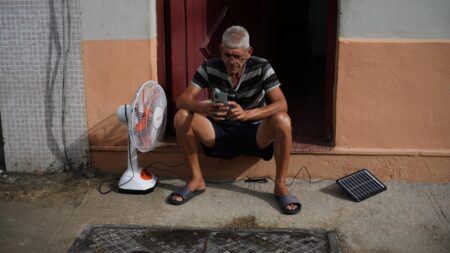
Cuban ingenuity, born from decades of scarcity and isolation, shines through even in these darkest times. Residents have developed creative solutions to cope with the constant blackouts that define their daily existence. Iván Amores uses a tiny, makeshift barbecue pit to cook for himself, his daughter, and young granddaughter, spending $3 on bags of pricier coal because it produces less smoke inside their home. He invested in a single tube light built and sold by an enterprising Cuban in another town—a rechargeable device that even includes a USB port for charging other items. For Minorkys Hoyos, a 53-year-old diabetic, survival means cooking cassava cubes in an old pot over a tiny improvised grill inside her home, using water from a barrel. “You live with what you have,” she explained simply, acknowledging she had no other food available at that moment. When the few rechargeable lights she owned broke down, she began bumping into things in the darkness of her small, disheveled home until a neighbor gifted her an improvised lantern made from fuel and a reused baby food jar. “When it’s dark, I don’t see,” she said matter-of-factly. Yet even these brilliant inventions that Cubans are famous for remain out of reach for the poorest residents, creating a hierarchy of hardship where some can afford minimal comforts while others live in complete deprivation.
A Brief Respite That Couldn’t Last
For three months, Santa Cruz del Norte experienced what felt like a miracle—they had electricity while most of Cuba suffered constant outages caused by aging infrastructure and fuel shortages at power plants across the island. But residents like Iván Amores remained cautiously pessimistic, fearful of celebrating their good fortune too enthusiastically, worried they would soon be plunged back into darkness as they had been for most of the previous year. Their fears proved justified when the outages returned with a vengeance just a week ago. “This used to be wonderful,” Amores recalled wistfully of his town during the brief period when it had reliable electricity. “Now, it’s truly torture.” The return of blackouts coincided with a cold snap that began in late January, making the situation even more miserable as temperatures plummeted to record lows, including 32 degrees Fahrenheit recorded in a town southeast of Santa Cruz del Norte. Neighbors could be seen walking briskly with buckets of warmed water so their families could take showers during the unusual cold. Near the main entrance to town, a sprawling mural proclaims in all capital letters: “NO ONE GIVES UP HERE. LONG LIVE A FREE CUBA.” But beneath this defiant message, people increasingly wonder how long they can actually hold out as the island’s crisis deepens with severe blackouts, soaring prices, and shortages of basic goods.
Finding Joy Despite the Darkness
Perhaps most remarkable is the resilience and determination of Santa Cruz del Norte’s residents to maintain their humanity and find moments of celebration despite the grinding hardship. Families have adapted their social lives to the new reality, with celebrations now starting earlier in the afternoon before darkness falls. One family organized a boy’s 15th birthday party—a milestone age across Latin America—in mid-afternoon, with the festivities continuing outdoors under a big yellow moon after the sun set. Young friends gathered, determined not to let the crisis steal their joy. Nearby, a group of people danced and sang outside next to a scooter blasting music from its speakers to celebrate Olga Lilia Laurenti’s 61st birthday. Taking a break from dancing, Laurenti shared her philosophy for surviving these times: “I’m telling you, whatever’s meant to be, let it be, because we can’t stop it. You’re not going to waste part of your life on something that’s out of your control. If only we could do something, but what are we going to do? We can’t suffer. You need laughter, you need joy.” Her words capture the spirit that keeps communities going even as the Cuban government remains silent about its oil reserves and whether Russia or anyone else will increase shipments after the U.S. disrupted supplies from Venezuela. Outside, children sat on a dusty sidewalk stacking dominoes to see how high they could build before everything tumbled down—an unintentional metaphor for life in Cuba today, where people build what they can with what they have, never knowing when it might all come crashing down.