



Discovering Denmark’s Lost Warship: A 225-Year-Old Story Emerges from Copenhagen Harbor
A Race Against Time Beneath the Waves
Deep beneath the murky waters of Copenhagen Harbor, marine archaeologists are working feverishly to uncover a piece of history that has lain hidden for more than two centuries. Fifty feet below the surface, where visibility is nearly nonexistent and thick sediment clouds the water, divers from Denmark’s Viking Ship Museum are excavating the wreck of the Dannebroge, a Danish flagship that met its dramatic end during the Battle of Copenhagen in 1801. The discovery, announced exactly 225 years after that fateful battle, has captured the imagination of historians and the Danish public alike. However, this is more than just an academic exercise – it’s a race against the clock. The wreck sits in an area slated to become part of Lynetteholm, an ambitious megaproject that will transform part of Copenhagen Harbor into a new housing district by 2070. Soon, construction will begin, and the site where this proud warship made its final stand will be forever changed. For the archaeologists involved, this is a unique opportunity to preserve and study a crucial moment in Danish history before it’s sealed beneath tons of concrete and development.
The Battle That Changed Denmark’s Fate
The story of the Dannebroge is inseparable from one of the most significant naval battles in European history. In 1801, the legendary British Admiral Horatio Nelson led his fleet in an attack on Denmark’s navy, which had formed a protective blockade outside Copenhagen Harbor. The British objective was clear but brutal: force Denmark out of the League of Armed Neutrality, an alliance of Northern European powers that included Russia, Prussia, and Sweden. What unfolded was a hourslong naval clash of extraordinary violence and determination, with thousands killed and wounded on both sides. The battle would go down in history as one of Nelson’s “great battles,” cementing his reputation as one of Britain’s greatest naval commanders. For Denmark, however, it was a devastating blow – both to their fleet and to their national pride. As Morten Johansen, head of maritime archaeology at the Viking Ship Museum, explains, “It’s a big part of the Danish national feeling.” The battle has been chronicled in countless books and depicted in numerous paintings over the centuries, but until now, much of what we knew came from observers watching from shore or from official records. The wreck itself offers something entirely different: the lived experience of those who fought and died aboard these wooden vessels as cannon fire tore through their ranks.
The Nightmare Aboard the Dannebroge
At the heart of that terrible day was the Dannebroge itself, a 157-foot warship commanded by Commodore Olfert Fischer. As the Danish flagship, it became Nelson’s primary target, and the British commander focused his fire on destroying it. The attack was relentless and catastrophic. Cannon fire shredded the upper deck, while incendiary shells sparked fires that spread through the wooden vessel. Johansen paints a vivid picture of what those final hours must have been like: “It was a nightmare to be on board one of these ships. When a cannonball hits a ship, it’s not the cannonball that does the most damage to the crew, it’s wooden splinters flying everywhere, very much like grenade debris.” Imagine being trapped on that deck, unable to escape, as your ship is systematically destroyed around you, with deadly wooden shrapnel flying in all directions with every hit. The battle also gave rise to one of the English language’s most enduring phrases. Nelson, who had lost sight in his right eye in an earlier engagement, famously decided to ignore a signal from a superior officer ordering him to withdraw. When questioned, he reportedly raised his telescope to his blind eye and declared, “I have only one eye, I have a right to be blind sometimes” – giving us the expression “to turn a blind eye.” Eventually, Nelson offered a truce, and a ceasefire was negotiated with Denmark’s Crown Prince Frederik. But for the Dannebroge, it was too late. The stricken vessel drifted slowly northward, burning, before finally exploding with such force that the sound echoed across all of Copenhagen.
Uncovering Personal Stories from the Deep
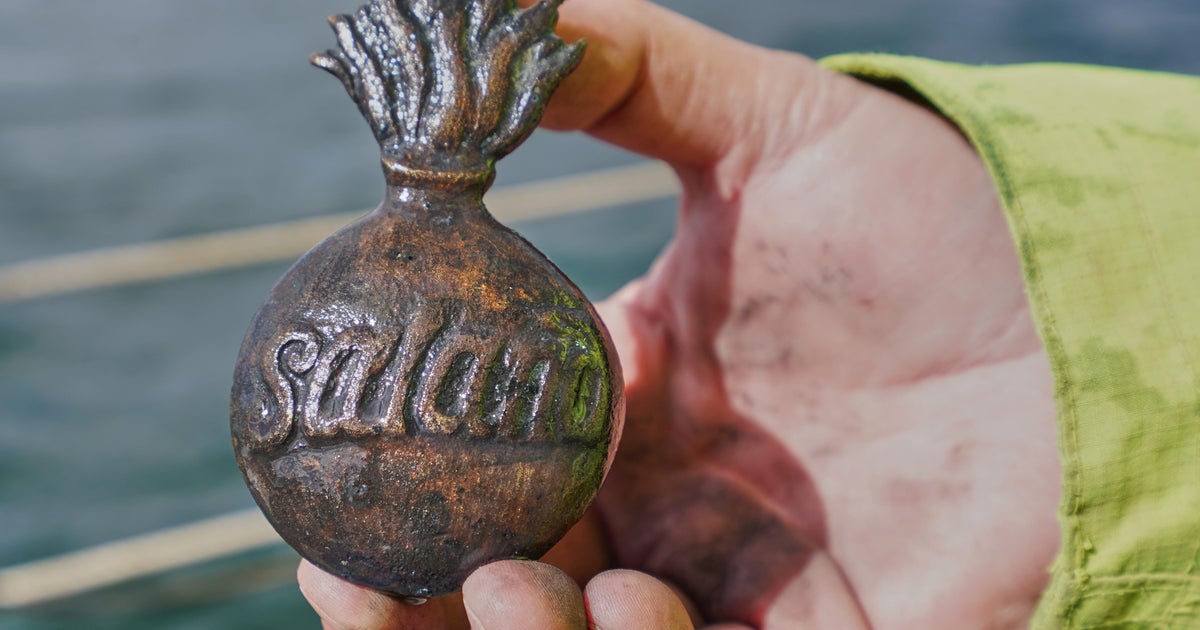
What makes this archaeological discovery so compelling isn’t just the historical significance of the ship itself, but the intimate human artifacts that are emerging from the sediment. The team has recovered two cannons, pieces of uniforms, military insignia, shoes, bottles, ceramics, and even fragments of basketry. Most poignantly, they’ve discovered part of a sailor’s lower jaw – possibly belonging to one of the nineteen crew members who remain unaccounted for and likely perished that day. These aren’t just objects; they’re windows into individual lives cut short more than two centuries ago. As diver and maritime archaeologist Marie Jonsson explains, “There are bottles, there are ceramics, and even pieces of basketry. You get closer to the people onboard.” For historians accustomed to working with official documents and secondhand accounts from observers, these artifacts offer something precious: a direct connection to the men who lived, fought, and died on that ship. The uniform fragments might have belonged to a young officer, the shoes to a common sailor, the bottles to men who shared a final drink before battle. Each artifact tells a story that no written account can fully capture, helping us understand not just what happened during the battle, but what it felt like to be there, to live through those terrifying hours as your world literally exploded around you.
The Challenge of Underwater Archaeology
The work of recovering these artifacts is itself a remarkable feat of determination and skill. Diving in Copenhagen Harbor is nothing like the crystal-clear waters often featured in underwater documentaries. Fifty feet below the surface, the archaeologists work in conditions that would challenge even experienced divers. The sediment is thick and easily disturbed, creating clouds that reduce visibility to absolutely nothing. When this happens, as Jonsson describes, “Sometimes you can’t see anything, and then you really have to just feel your way, look with your fingers instead of with your eyes.” The divers must navigate by touch alone, carefully feeling their way across the wreck site, identifying objects by texture and shape rather than sight. Adding to the challenge, the site is littered with live cannonballs – both a historical treasure and a navigational hazard for divers who can’t see where they’re swimming. The experts have confirmed they’re working on the right wreck through multiple lines of evidence: the sizes of wooden components match old drawings of the Dannebroge, dendrochronological dating (which uses tree rings to date wood) confirms the ship was built in the correct time period, and the sheer quantity of cannonballs and battle damage is consistent with the flagship’s known fate. Despite the difficulties, the team continues their painstaking work, knowing that every day brings them closer to the moment when construction begins and access to the site becomes impossible.
A Window into Denmark’s Soul and Maritime Heritage
This discovery comes at a time when underwater archaeology is yielding remarkable finds across Scandinavia and beyond. Just weeks before the Dannebroge announcement, a 17th-century Swedish Navy shipwreck that had been buried underwater in Stockholm for 400 years suddenly became visible due to unusually low Baltic Sea levels. Last year, two 18th-century shipwrecks discovered off Costa Rica, once thought to be pirate vessels, were confirmed to be Danish slave ships – a darker chapter in Denmark’s maritime history. But the Dannebroge holds a special place in the Danish imagination. The Battle of Copenhagen is deeply woven into the nation’s story, taught in schools and commemorated in art and literature. For many Danes, it represents a moment of both tragedy and national resilience – their fleet was defeated, but their nation survived and ultimately thrived. What the archaeologists hope to achieve goes beyond simply recovering artifacts or confirming historical records. As Johansen notes, “A great deal has been written about the battle by very enthusiastic spectators, but we actually don’t know how it was to be onboard a ship being shot to pieces by English warships and some of that story we can probably learn from seeing the wreck.” By examining the physical evidence, by touching the objects held by men in their final moments, by studying the pattern of damage and the distribution of artifacts, researchers can reconstruct not just events but experiences – bringing us closer to understanding what it meant to be Danish, to be a sailor, to be human during that pivotal moment in history. As the Lynetteholm project moves forward and Copenhagen continues to evolve, this monthslong excavation represents a brief window to preserve something irreplaceable before it’s sealed away forever beneath the modern city rising above.