


The Artemis II Mission: Humanity’s Return to the Moon After Five Decades
Crew Arrives at Kennedy Space Center for Historic Launch
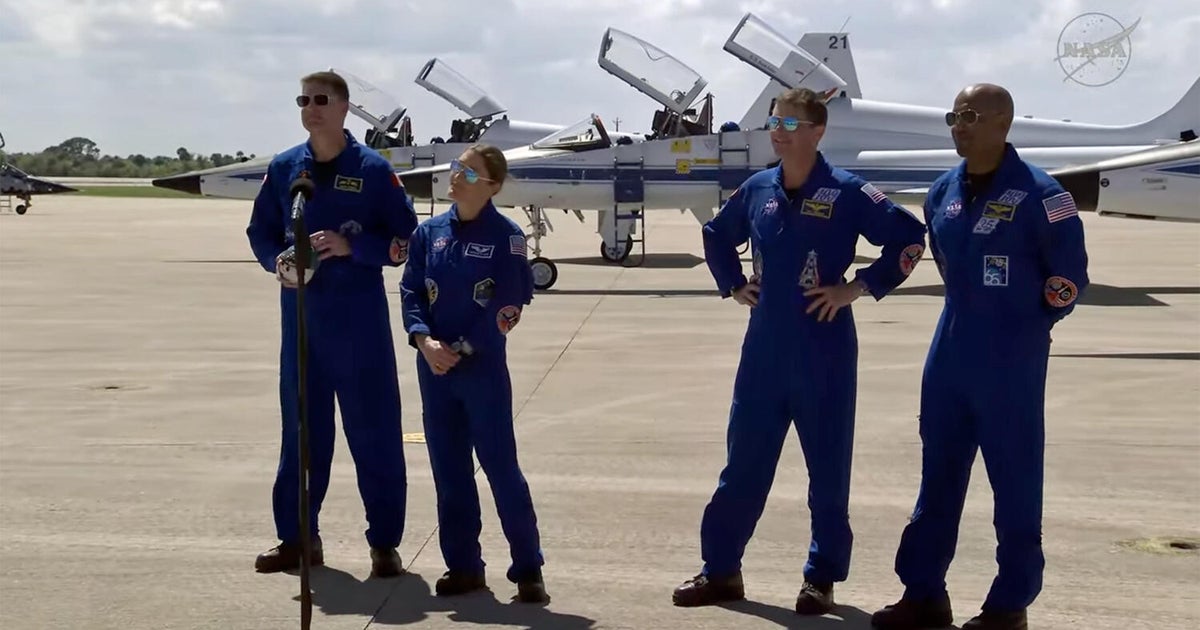
The stage is set for one of the most momentous space missions in recent history. On Friday, four astronauts touched down at Florida’s Kennedy Space Center, their arrival marking the beginning of the final countdown to a journey that will take humans beyond Earth orbit for the first time in over fifty years. Commander Reid Wiseman, Victor Glover, Christina Koch, and Canadian astronaut Jeremy Hansen arrived in style aboard sleek T-38 jets, landing on the spaceport’s iconic three-mile runway at approximately 2:10 p.m. Eastern Time. They had flown in from NASA’s Johnson Space Center in Houston, leaving behind months of rigorous training to begin their final preparations for a mission that has captured the world’s imagination. The energy was palpable as the crew stepped onto the tarmac, with Commander Wiseman’s enthusiastic declaration—”Hey, let’s go to the moon!”—perfectly capturing the excitement of the moment. With fists pumping and smiles all around, the crew addressed an unusually large gathering of reporters and photographers, reflecting the intense global interest in NASA’s first lunar mission in more than half a century. The scheduled launch on April 1 will send these four pioneering astronauts on an incredible nearly 700,000-mile voyage around the moon and back, retracing and extending the path blazed by the Apollo astronauts decades ago.
Overcoming Technical Challenges on the Road to Launch
The journey to this moment hasn’t been without its obstacles, revealing the immense complexity of returning humans to deep space after such a long hiatus. The crew originally targeted an early February launch date, but technical issues forced NASA to push back the timeline. First, engineers detected troubling hydrogen leaks during a critical fueling test—the kind of problem that absolutely must be resolved before putting human lives at risk. Then, additional complications arose with pressurizing the rocket’s upper stage propulsion system, a vital component for the mission’s success. When it became clear that this particular problem couldn’t be fixed while the massive Space Launch System (SLS) rocket stood on the pad, NASA made the difficult decision to roll the 322-foot-tall vehicle back to the Vehicle Assembly Building, the cavernous facility that has housed America’s most ambitious rockets for generations. Fortunately, technicians quickly identified the culprit: a simple but critically misplaced seal. After fixing that issue and recharging various batteries throughout the rocket system, the behemoth was once again transported to the launch pad. Despite these setbacks, Commander Wiseman maintained a realistic and measured perspective, acknowledging to CBS News that while the team is ready to launch, the complexity of loading millions of pounds of propellant onto a giant machine destined for the moon means another delay remains a possibility. The countdown clocks are expected to start ticking at 4:44 p.m. EDT on Monday, setting up a launch attempt at 6:24 p.m. on Wednesday, with a two-hour launch window to provide some flexibility.
Testing Cutting-Edge Technology with a Human Crew
Artemis II represents a pivotal milestone in aerospace technology, marking only the second flight of the Space Launch System—currently the most powerful operational rocket in the world—and the first time it will carry human passengers. The same historic “first” applies to the Orion crew capsule perched atop the towering rocket. Before the astronauts set course for the moon, they’ll spend an entire day in Earth orbit conducting a thorough shakedown cruise of their spacecraft. This crucial period will allow them to verify that all of Orion’s life support systems and critical components are functioning exactly as designed—something that simply couldn’t be fully tested during the uncrewed Artemis I mission. As Commander Wiseman explained in an earlier interview, this 24-hour orbital checkout provides essential time to test the environmental control and life support systems that will keep the crew alive. Can the system effectively remove carbon dioxide from the cabin air? Will the water systems work properly? Can the crew perform all basic human functions safely in this new spacecraft? These might seem like mundane questions, but they’re absolutely critical before committing to the journey beyond Earth orbit. The crew is also bringing along a charming companion: a small plush toy named “Rise” that will serve as their informal zero gravity indicator—a lighthearted tradition among astronauts. Astronaut Christina Koch explained that the toy, selected by the crew from contest entries, was designed by a California second-grader and resonates with the team because its theme references the iconic Earthrise photograph taken during the Apollo 8 mission, an image that has inspired generations of space explorers and Earth-lovers alike.
The Lunar Journey and What Lies Ahead
If everything proceeds according to plan, the Orion capsule will sweep within approximately 4,100 miles of the moon on April 6, offering the astronauts spectacular and unprecedented views of the lunar far side—the hemisphere that never faces Earth and remains hidden from our view. This close lunar approach will serve a practical purpose as well: the moon’s gravity will act like a cosmic slingshot, bending the spacecraft’s trajectory back toward Earth in a carefully calculated arc. The mission is scheduled to conclude with re-entry through Earth’s atmosphere and splashdown in the Pacific Ocean near San Diego on April 10, bringing the astronauts safely home after their historic journey. Tucked inside that plush toy “Rise” will be a computer card carrying the names of nearly six million people from around the world who participated in NASA’s “send your name around the moon” campaign—a touching reminder that this mission represents the dreams and aspirations of people everywhere, not just the four individuals aboard the spacecraft. Due to the constantly changing orbital mechanics between Earth and moon, along with requirements for proper lunar lighting and solar power availability, the launch window remains open only until April 6. If the crew cannot launch by that date, they’ll face a delay of approximately four weeks until conditions once again align favorably for the mission.
Building Toward a Sustainable Lunar Presence
Artemis II is far more than a single mission; it represents the crucial second step in NASA’s ambitious plan to establish a sustainable human presence on and around the moon. This flight will set the stage for a follow-on mission scheduled for next year, when another crew will remain in Earth orbit to test rendezvous and docking procedures with commercial moon landers currently being developed by SpaceX and Blue Origin. These private-sector spacecraft represent a new era of public-private partnership in space exploration, leveraging commercial innovation to achieve national and international space goals. If these preparatory flights succeed as planned, NASA is targeting 2028 for one—and possibly two—actual lunar landing missions that will put astronauts back on the moon’s surface for the first time since 1972. But the agency’s vision extends even further into the future. Plans are already underway to construct a moon base near the lunar south pole, a region of particular interest because of the presence of water ice in permanently shadowed craters. This base would enable long-duration stays on the surface, transforming humanity’s relationship with our nearest celestial neighbor from brief visits to sustained occupation. The south pole location would provide access to vital water resources while also offering sites with nearly continuous sunlight for solar power generation—essential ingredients for a self-sustaining outpost.
A Mission That Inspires the World
Speaking at the runway press conference, astronaut Christina Koch addressed the recent announcements about NASA’s evolving approach to space exploration and the pathway to the moon and eventually Mars. “The one thing the crew all agrees on is that it has been motivating. It has been inspiring, and it has fired us up,” she said, her words reflecting not just personal enthusiasm but the renewed sense of purpose that has energized the entire space program. The Artemis II crew brings diverse experience to this historic mission: Koch, Wiseman, and Glover are all NASA veterans who have proven themselves in previous spaceflights, while Hansen will be making his first journey to space, representing Canada’s contribution to international lunar exploration. The unusually large crowd of journalists and photographers who greeted them at Kennedy Space Center underscores the broad public interest in this mission—a level of attention not seen for a space launch in decades. Commander Wiseman’s reflections on the journey captured the weight of the moment: “I think the nation and the world has been waiting a long time to do this again,” he said. “It’s been a lot of work. It’s been a great journey.” As the massive SLS rocket stands ready on the launch pad, fueled not just with propellant but with the hopes and dreams of millions, humanity stands on the threshold of a new chapter in space exploration—one that promises to take us not just around the moon, but eventually to Mars and beyond, fulfilling what Koch called “our destiny in space.”