

A Sacred Standoff: When Police Barred Jerusalem’s Patriarch from Holy Week Services
An Unprecedented Denial of Access
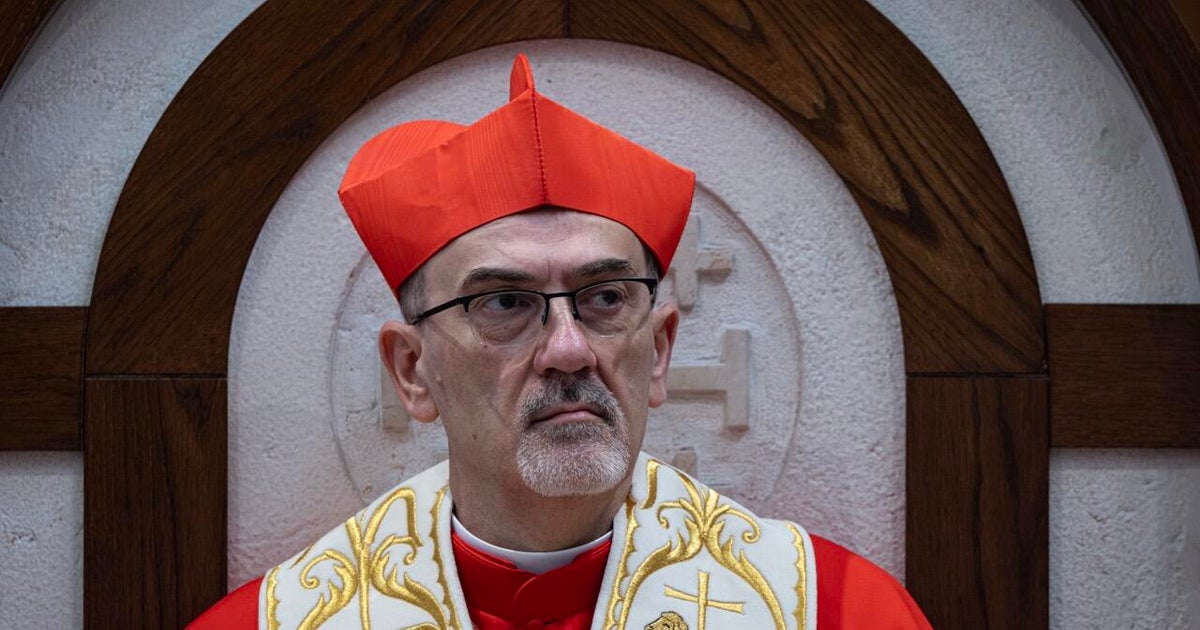
In an incident that has sent shockwaves through the global Christian community, Israeli police prevented Cardinal Pierbattista Pizzaballa, the Latin Patriarch of Jerusalem and one of the most senior Catholic officials in the Holy Land, from entering the Church of the Holy Sepulchre to celebrate Palm Sunday Mass. The event marks a historic disruption of religious traditions that have continued uninterrupted for centuries, even through periods of war and political upheaval. According to the Latin Patriarchate of Jerusalem, both Cardinal Pizzaballa and Reverend Fr. Francesco Ielpo were stopped as they attempted to make their way to the church for the celebration. What makes this particularly striking is that the religious leaders were not part of any large procession or ceremonial parade—they were simply trying to enter privately to conduct their pastoral duties. The Patriarchate’s statement emphasized the gravity of the situation, noting that “for the first time in centuries, the Heads of the Church were prevented from celebrating the Palm Sunday Mass at the Church of the Holy Sepulchre.” This wasn’t just an administrative inconvenience; it represented a fundamental disruption to religious observance during one of the holiest weeks in the Christian calendar, affecting not just those present in Jerusalem but touching the hearts of billions of believers worldwide who turn their eyes toward the Holy City during this sacred time.
Security Concerns and Contested Explanations
Israeli police defended their decision by citing security restrictions that have been in place since the outbreak of war with Iran. Speaking to Agence France-Presse, police officials stated they had received a request from Cardinal Pizzaballa that “could not be approved” due to existing limitations on gatherings. Their reasoning centered on practical safety concerns: Jerusalem’s Old City, with its ancient narrow streets and historic architecture, doesn’t allow easy access for large emergency vehicles and rescue teams in the event of a “mass casualty incident.” Israeli authorities have implemented strict measures limiting public gatherings to approximately 50 people and have closed all holy sites in Jerusalem since the conflict began. However, the police explanation left many questions unanswered, as officials did not specify exactly what the Cardinal’s request entailed or why two religious leaders entering privately—not with a crowd—posed such a significant security threat. The Latin Patriarchate strongly disputed the characterization of events, insisting that the Cardinal and his companion were proceeding quietly and privately, without any ceremonial fanfare or accompanying procession that might draw crowds. The organization described the police action as “manifestly unreasonable and grossly disproportionate,” calling the decision “hasty and fundamentally flawed” and suggesting it was “tainted by improper considerations.” This gap between the official security justification and the actual circumstances of two individuals seeking private entry has fueled suspicions that other factors may have influenced the unprecedented denial of access.
The Sacred Significance of Palm Sunday and Holy Week
To understand why this incident resonates so deeply with Christians around the world, it’s essential to grasp what Palm Sunday represents in the Christian faith. This day marks the beginning of Holy Week, the most solemn and significant period in the Christian liturgical calendar, which culminates in Easter Sunday. Palm Sunday commemorates Jesus Christ’s triumphal entry into Jerusalem just days before his crucifixion, when crowds welcomed him by laying palm branches in his path and hailing him as king. For Christians, this moment represents the beginning of the Passion narrative—the story of Christ’s suffering, death, and resurrection that forms the cornerstone of Christian theology. The Church of the Holy Sepulchre, where Cardinal Pizzaballa was prevented from celebrating Mass, holds profound importance as the traditional site where Jesus was crucified, buried, and rose from the dead. For nearly two thousand years, Christians have gathered at this sacred location to mark these events, making it one of the holiest sites in Christianity. The traditional Palm Sunday procession that normally takes place—starting from the Mount of Olives and proceeding into Jerusalem’s Old City—reenacts Christ’s final journey into the city, allowing modern believers to literally walk in his footsteps. While this year’s procession had already been cancelled due to security restrictions, the expectation remained that at minimum, church leaders would be able to conduct Mass inside the church itself. The prevention of even this basic observance represented a breach of religious continuity that many found deeply troubling, transforming what should have been a day of spiritual celebration into one marked by disappointment and concern about religious freedom in the Holy Land.
International Outcry and Diplomatic Tensions
The incident quickly escalated beyond a local religious matter to become an international diplomatic issue, with world leaders across Europe and the Middle East voicing strong criticism of Israeli police actions. Italian Prime Minister Giorgia Meloni was among the first to speak out, characterizing the incident as “an offence not only to the faithful but to any community that respects religious freedom.” Her words reflected the view that this wasn’t merely about one Mass on one day, but about fundamental principles of religious liberty that transcend national boundaries and political conflicts. Italy’s foreign minister Antonio Tajani took concrete diplomatic action by summoning Israel’s ambassador to discuss what he termed an “unacceptable” incident, signaling that the matter carried serious implications for bilateral relations. French President Emmanuel Macron also weighed in, condemning the police action and emphasizing that worship “for all religions” must be guaranteed in Jerusalem. Significantly, Macron placed the incident within a broader pattern, stating that the police action “adds to a worrying series of violations of the status of holy places in Jerusalem”—suggesting concerns that religious freedoms in the city are facing systematic erosion rather than isolated interference. Jordan’s foreign ministry issued perhaps the strongest condemnation, describing the incident as a “flagrant violation of international law and international humanitarian law, as well as the prevailing legal and historical status quo, and an infringement on the unrestricted freedom of access to places of worship.” This language invoked the complex international legal frameworks that govern Jerusalem, where the status of holy sites has been carefully negotiated and protected through decades of agreements and understandings among multiple parties with interests in the city’s religious heritage.
The Human Cost: Worshippers’ Disappointment and Loss
Beyond the diplomatic statements and official protests, the incident had a profound impact on ordinary Christian worshippers who had hoped to mark Holy Week in the traditional manner. In Jerusalem’s Old City, Christian residents and pilgrims expressed their sadness and frustration to journalists, describing a sense of mourning for lost traditions and communal religious experiences. Andre, a 51-year-old worshipper who gave only his first name, captured the emotional weight of the disruption: “It’s very sad this year. Because we are always used to the procession that starts from the Mount of Olives, but this year because of the precautions of the war it’s forbidden.” His words reflected not anger but a deep melancholy at being denied the ritual observances that connect believers to their faith history and to fellow Christians across generations. Another worshipper, 25-year-old Simon Hosh, echoed similar sentiments: “This year, because of the war, we cannot celebrate in the streets like always. So this year we just celebrate in the church. It’s bad.” The simplicity of his final assessment—”It’s bad”—conveyed a profound sense of loss that formal statements couldn’t quite capture. For these believers and countless others, Holy Week isn’t just about individual prayer but about communal celebration, public witness, and the physical experience of walking ancient paths and gathering in sacred spaces. The security restrictions transformed what should have been a week of spiritual renewal into a diminished, constrained experience conducted behind closed doors with limited attendance, removing much of the joy and communal energy that normally characterize these celebrations.
Broader Implications for Religious Freedom and Coexistence
This incident raises troubling questions about the future of religious freedom in Jerusalem and the delicate balance between legitimate security concerns and the protection of sacred rights during times of conflict. In his Palm Sunday address in Rome, Pope Leo XIV acknowledged “the Christians of the Middle East, who suffer the consequences of a terrible conflict and in many cases cannot fully live the rites of these holy days,” though the Vatican notably refrained from directly commenting on the specific incident in Jerusalem. The silence from the Holy See might reflect diplomatic caution, but it also underscores the complex politics surrounding religious access in Jerusalem, where any statement can carry unintended consequences for the Christian communities who continue to live in the region. The fundamental question remains: can security requirements be met while still preserving the core religious freedoms that make Jerusalem sacred to billions of believers worldwide? The Latin Patriarchate’s argument that two individuals entering privately poses no credible security threat deserves serious consideration, as does the historical precedent of religious observances continuing even during previous wars and periods of instability. If church leaders can be barred from their own sacred sites during the holiest week of the year, what precedent does this set for future restrictions? The international response suggests that many governments view this incident not as an isolated security decision but as part of a pattern that threatens the carefully maintained religious status quo in Jerusalem—a city that belongs spiritually to Christians, Jews, and Muslims alike. As tensions continue in the region, the challenge will be finding security measures that protect lives without suffocating the religious traditions that give Jerusalem its unique and irreplaceable character as a city sacred to half the world’s population.