



Celebrating Yayoi Kusama: A Journey Through Eight Decades of Artistic Wonder
A Landmark Exhibition Honoring a Living Legend
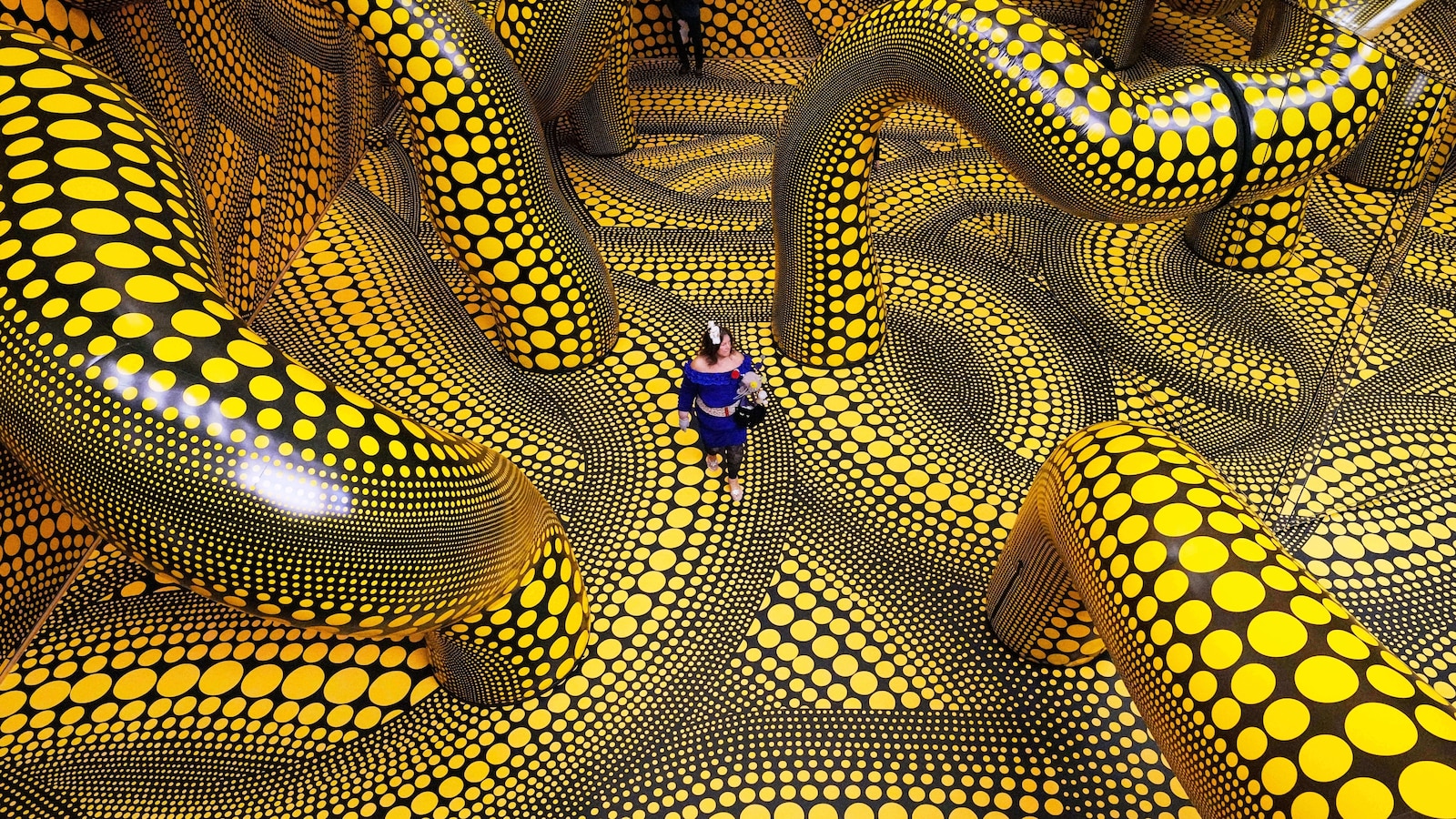
The Museum Ludwig in Cologne, Germany, is marking its golden jubilee with an extraordinary tribute to one of contemporary art’s most captivating figures. Opening its doors to visitors this Saturday, the museum presents a comprehensive retrospective of Yayoi Kusama’s work, featuring more than 300 pieces that span the remarkable career of this Japanese artistic icon. The exhibition, which will run through August 2nd, transforms the museum into an immersive wonderland of color, pattern, and imagination. Visitors are greeted by Kusama’s signature elements throughout the building—from mirror rooms adorned with vibrant colored dots to eye-catching flower sculptures perched on the rooftop, creating a striking contrast against Cologne’s historic cathedral. The museum entrance showcases her beloved “Pumpkin” sculpture from 2009, a cheerful piece made of fiber-reinforced plastic and polyurethane paint, while inside, massive octopus-like tentacles guide guests through a captivating maze of spatial experiences. This ambitious show represents not just a celebration of the museum’s half-century milestone, but also a profound recognition of an artist whose influence has shaped contemporary art for generations.
From Traditional Japan to Global Icon
Yayoi Kusama’s life story reads like an epic novel of personal transformation and artistic revolution. Born in 1929 in Matsumoto, Japan, she grew up surrounded by the lush greenhouses and sprawling fields of her family’s extensive seed nursery—an environment that would profoundly influence her artistic vision and her deep connection to the natural world. Her early years in patriarchal postwar Japan were challenging, but her artistic spirit refused to be contained by convention. In the mid-1930s, while still a young girl, Kusama created her first drawing, beginning a creative journey that would eventually span more than eight decades. Her path led her from Japan to New York City, where she arrived as a young artist ready to challenge the male-dominated art world of the time. During the transformative 1960s, she became deeply involved in the counterculture movements, embracing the Flower Power aesthetic and participating in anti-Vietnam War demonstrations. After establishing herself as a significant presence in the American art scene, Kusama returned to Japan in 1973, where she has continued to create and evolve as an artist. Now approaching her 97th birthday this month, she has achieved something few artists experience in their lifetime—becoming both a critical success and a social media phenomenon whose work resonates across generations.
The Power of Patterns and the Language of Dots
What makes Kusama’s work so universally appealing is its ability to speak to something fundamental in human experience while maintaining an utterly unique visual language. Her famous polka dots and vibrant color palettes aren’t simply aesthetic choices—they’re deeply personal symbols rooted in her childhood experiences and ongoing psychological journey. As a young girl, Kusama began experiencing vivid hallucinations, some involving polka dots or flowers that seemed to spread and multiply around her, covering surfaces and extending into infinity. Rather than being defeated by these overwhelming visions, she transformed them into her artistic signature, turning personal struggle into universal beauty. Her work explores themes of infinity, self-obliteration, and the interconnectedness of all things through repeating patterns that seem to pulse with life. The exhibition at Museum Ludwig showcases this evolution beautifully, featuring works that range from intimate drawings to room-sized installations. Among the highlights is “The Universe as Seen from the Stairway to Heaven,” a breathtaking creation made from mirrors, glass, and acrylic sheets that invites viewers to contemplate their place in the cosmos. The show also includes a newly commissioned “Infinity Mirror Room” created specifically for this exhibition, demonstrating that even in her tenth decade, Kusama continues to push creative boundaries and explore new ways of engaging audiences with her distinctive vision.
Nature, Memory, and the Creative Spirit
The rooftop installation at Museum Ludwig offers visitors a particularly moving experience, connecting Kusama’s art to the open sky and the historic cityscape of Cologne. Here, her painted-bronze sculptures titled “Flowers That Speak All about My Heart Given to the Sky” from 2018 reach upward with characteristic exuberance, their bright forms seeming to dance in conversation with the cathedral spires nearby. These works embody Kusama’s lifelong fascination with flowers and organic forms, harking back to those formative years spent in her family’s nursery, where she first learned to see the world through the lens of growth, color, and natural pattern. Another remarkable piece in the exhibition, “I’m Here, but Nothing,” uses fluorescent stickers and ultraviolet lights to transform everyday household objects into something otherworldly and magical, challenging our perceptions of the ordinary and familiar. The exhibition also features her powerful series “My Eternal Soul, 2009-2021,” a patchwork of paintings that burst with energy and emotion, each canvas a window into the artist’s ongoing dialogue with existence itself. According to curator Stephan Diederich, the show is “very diverse, wide-ranging, and depicts an immensely rich, creative life spanning more than eight decades, still looking ahead.” This forward-looking quality is perhaps what makes Kusama’s work so timeless—she has never been content to rest on past achievements but continues to explore, experiment, and create with undiminished passion.
Art as Survival and Celebration
Behind the joyful colors and playful forms of Kusama’s work lies a deeper story of resilience and the healing power of artistic expression. Throughout her long career, the artist has been open about her struggles with mental health, including depression and existential anxiety. For years, she has lived in relative seclusion in a Tokyo clinic, yet this has not dimmed her creative output—she continues to work every day, as her health allows, transforming her inner experiences into art that connects with millions of people worldwide. In a statement provided for the exhibition, Kusama reflected on this relationship between her art and her wellbeing: “In my more than 70 years as an artist, I have always been in awe of the wonder of life. More than anything, this strong sense of the life force in artistic expression is what has supported me and gave me power to overcome feelings of depression, hopelessness and sadness.” These words reveal the profound truth at the heart of her practice—art is not merely decoration or intellectual exercise, but a vital force for survival, transformation, and transcendence. Her work offers a model for how creativity can serve as both personal salvation and universal gift, showing us that beauty and meaning can emerge from even the most challenging circumstances.
A Cultural Phenomenon for the Ages
Curator Stephan Diederich’s assessment that “Kusama is undoubtedly one of the most significant artists of our time” reflects a consensus that has grown across the art world and popular culture alike. Her mirror rooms, balloon installations, and ubiquitous polka dots have achieved cult status, becoming instantly recognizable icons that transcend the traditional boundaries between high art and popular culture. In an age dominated by social media and viral images, Kusama’s work has found a new generation of admirers who flock to her exhibitions to experience and photograph her immersive environments. Yet this popular success hasn’t come at the expense of critical respect—her work is celebrated in major museums worldwide and continues to influence younger artists across various disciplines. The Cologne exhibition, while celebrating the past, also emphasizes Kusama’s ongoing relevance and forward momentum. Though she communicated with the curatorial team only indirectly due to her circumstances, she took an active interest in how her work would be presented, demonstrating the same attention to detail that has characterized her entire career. As visitors walk through Museum Ludwig’s galleries, from the mirror rooms to the rooftop sculptures, they’re not just viewing the work of a historical figure but engaging with a living artist whose creative vision remains as vital and necessary as ever. In a world often marked by division and despair, Kusama’s art offers something increasingly precious—a sense of wonder, connection, and the transformative power of seeing the world through eyes of infinite imagination.