


A Historic Journey on Ice: Tallulah Proulx Makes Winter Olympic History for the Philippines
The Heart-Stopping Moment That Changed Everything
Picture this: a seventeen-year-old girl and her mother sitting in their car on a cold mountain in northern California, hearts pounding as they waited to learn if years of sacrifice and dedication had paid off. Tallulah Proulx had just completed her final slalom qualifier for the 2026 Winter Olympics, and in those agonizing moments of uncertainty, she had no idea she was about to make history. When the news finally came through, it was almost too good to believe—she had qualified for the Milano Cortina Games by the slimmest of margins. But this wasn’t just any qualification. Tallulah had become the first female from the Philippines to compete in a Winter Olympics and the country’s youngest Winter Olympian ever.
The relief and joy were immediate and overwhelming. “I was like, so happy, so excited, and it didn’t feel real,” Tallulah recalled, her voice still carrying traces of that magical disbelief. In a touching detail that speaks volumes about the unconditional support of her mother, there was already a cookie waiting in the car—originally prepared as consolation if things hadn’t worked out. Instead, it became a celebration cookie, enjoyed during the drive home as mother and daughter laughed and celebrated together, all the nervousness that had followed Tallulah down the mountain melting away into pure happiness. That finish line in California wasn’t an ending at all—it was the starting gate for her journey to Cortina, Italy, where she would represent the Philippines on the world’s biggest winter sports stage.
From Tiny Skis to Big Dreams
Every great Olympic story starts small, and Tallulah’s began at the height of a toddler—literally. She was only three years old when she first clicked into a pair of skis, so young that the mountain must have seemed like an entire world. Growing up in Berkeley, California, her family made skiing a cherished tradition, driving three hours to Lake Tahoe for weekend adventures on the slopes with Tallulah and her brother. Those early days were about family fun and the simple joy of sliding down snowy hills, but even then, something was taking root—a love for the sport that would shape her entire life.
That love faced its first real test when Tallulah was seven years old and her mother’s job required the family to move to Iowa. If you know anything about Iowa, you know it’s not exactly known for its world-class skiing—”Iowa is very flat,” Tallulah laughed as she recalled those years. The state does have one small ski area called Sundown Mountain, and while Tallulah gave it an affectionate shout-out, she acknowledged its limitations. Sundown only had a race team, which meant her skiing took a more competitive turn out of necessity rather than choice. But even in the flatlands of the Midwest, far from the towering peaks and deep powder she’d known in California, the mountains kept calling to her.
A Family’s Sacrifice and Unwavering Support
When Tallulah was ten years old, her parents made a decision that would change the trajectory of her life. They enrolled her in a full-time, six-day-a-week ski program in Vail, Colorado—a serious commitment that spoke to their belief in their daughter’s potential and passion. A year later, in 2018, the family moved again, this time to Park City, Utah, one of America’s premier skiing destinations, so Tallulah could continue chasing her dream of speed, snow, and shaving seconds off her times. These weren’t easy decisions. They required significant financial investment, logistical challenges, and the kind of faith in a child’s dream that not every family can muster.
“My family was incredibly supportive of my journey from the beginning,” Tallulah explained, her gratitude evident in every word. “They are the ones who sent me to Vail to pursue my passion, even though it wasn’t necessarily ideal for all of us. It was kind of difficult for the family, so they ended up moving to Park City, but they were the ones who believed in me and believed in my dream.” This is the part of Olympic stories we don’t always see—the parents rearranging their entire lives, the siblings adapting to constant change, the family sacrifices that happen behind the scenes. For Tallulah, none of this journey would have been possible without her family’s willingness to put her dreams first, to uproot themselves repeatedly, and to believe in her even when the path forward wasn’t clear.
Choosing a Path: Strategy Meets Heritage
As Tallulah’s skills developed and Olympic dreams became more concrete, she and her family faced a crucial decision: Should she try to represent Team USA or Team Philippines? Tallulah is a dual national, connected to the Philippines through her heritage, and this opened a door that might otherwise have remained closed. The decision came down to a combination of strategy and realism about what was actually achievable. “We definitely were, first of all, thinking of the best and easiest way,” Tallulah explained honestly. “There are far fewer athletes competing for the Philippines than there are for the U.S.”
The mathematics of competition were stark. To make Team USA, Tallulah would likely need to take a gap year from school, work her way up through the U.S. Ski Team system, and then compete against an enormous pool of talented American skiers for one of just a handful of Olympic spots. The odds were daunting. “I definitely would not be here where I am right now if I was under the U.S. flag,” she admitted candidly. There’s no shame in this calculation—it’s the reality of Olympic sports, where the path to the Games can vary dramatically depending on which country you represent. By choosing to ski for the Philippines, Tallulah wasn’t taking an easy way out; she was making a strategic decision that honored her heritage while giving her the best chance to achieve her Olympic dream.
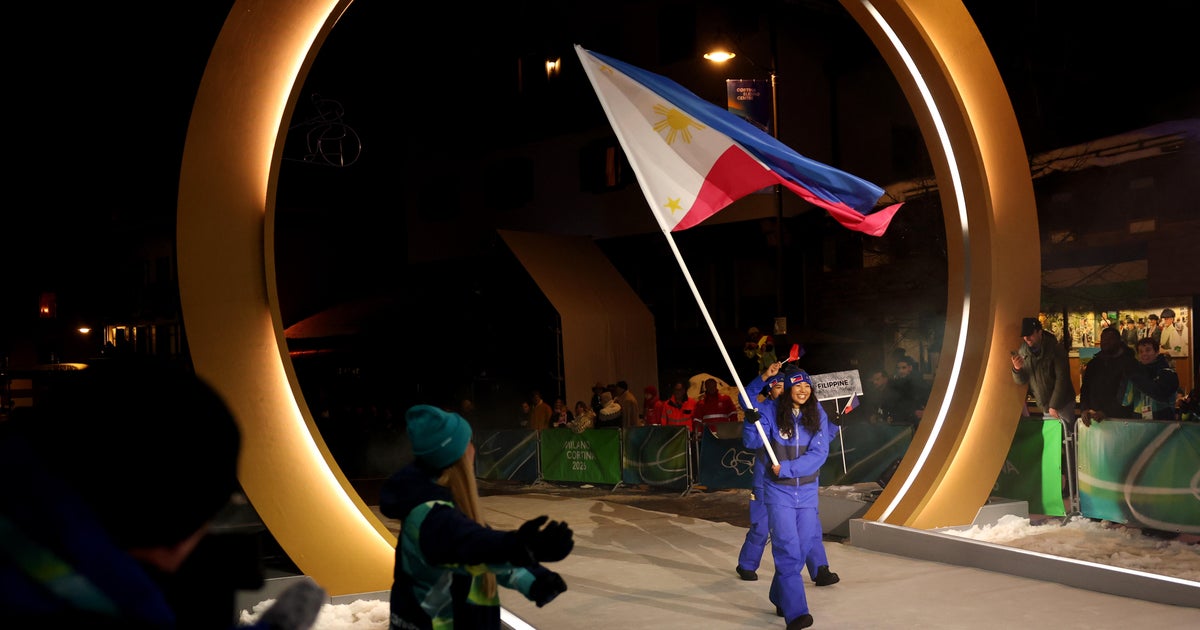
That decision culminated in one of the most meaningful moments of her young life: serving as the flag bearer for the Philippines at the Opening Ceremony in Cortina on February 6, 2026. Walking into that Olympic stadium beneath the red, white, and blue—and the yellow sun and stars—of the Republic of the Philippines, Tallulah carried not just a flag, but the hopes and pride of an entire nation. For a country not traditionally associated with winter sports, her presence alone was historic and inspiring.
Pressure, Pride, and the Power of Representation
Standing on the precipice of her first major international competition, Tallulah is refreshingly honest about her feelings. “I’m definitely feeling some pressure,” she acknowledged. “This is my big, first, like, international competition with this insanely high level of athletes.” The Milano Cortina Games represent a massive step up from anything she’s experienced before, competing against the world’s best skiers on one of the biggest stages in sports. But Tallulah has already demonstrated the mental toughness that separates good athletes from great ones. “Whatever the outcome may be, I’ll just keep a positive mindset and just have fun and be here for the experience,” she said. “And I’m really excited to show the Philippines and show the world what the Philippines can do.”
That last part—representing the Philippines on a global stage—adds an extra dimension to Tallulah’s Olympic experience. She’s not just skiing for herself or even for her family; she’s skiing for everyone in the Philippines who will see themselves in her achievement, for every young Filipina who might now believe that winter sports are for them too. “You know, I think that Filipinos are one of the most supportive-type people around,” she said warmly. “I just want to say to all the Filipinos out there watching, like, we’re so strong, we can do it… be proud in our identity—and I think that it’s so important that, you know, I’m here for the Winter Olympics, being like a first step.”
Blazing a Trail for Others to Follow
Now, as Tallulah prepares to compete in Cortina, she’s thinking beyond her own performance to the legacy she might leave behind. She hopes the tracks she carves in the Italian snow will become trails that others can follow, paths that young Filipinos—and young people everywhere—can see and believe they too can travel. Her message to aspiring athletes is simple but powerful: “If you’re passionate and surrounded by the right people who are supportive of you and you have that passion in your heart and also a kindness to others, I think that you can pursue whatever you want.”
This is what representation really means—not just being present, but opening doors, challenging assumptions, and expanding possibilities. Before Tallulah, the idea of a Filipina competing in alpine skiing at the Winter Olympics might have seemed impossible, a dream too distant to even entertain. Now it’s a reality, captured in photographs and recorded in Olympic history. Every young person who sees her compete will know with certainty that it can be done, that geographic and cultural barriers don’t have to define what’s possible. Whether Tallulah wins a medal or not, she’s already achieved something remarkable: she’s shown up, she’s represented, and she’s made history. That seventeen-year-old girl who sat nervously in a car in California, eating a celebration cookie with her mom, is now an Olympic athlete and a pioneer. And her journey is just beginning.