
Tiger Woods Arrested Following Rollover Crash in Florida
The Incident on Jupiter Island
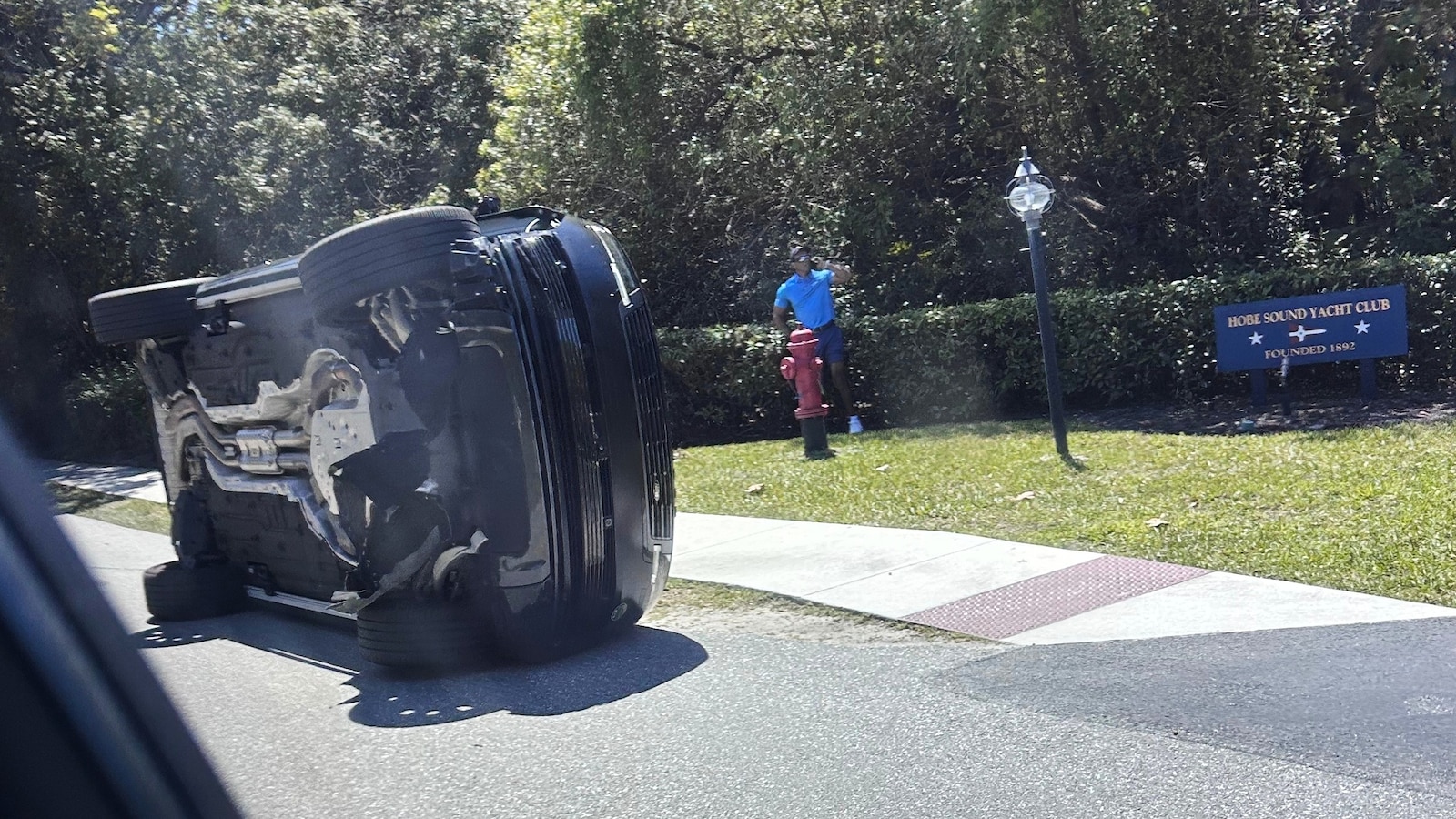
On a Friday afternoon that shocked the sports world, golf legend Tiger Woods found himself in serious legal trouble after a dramatic rollover crash on Jupiter Island, Florida. According to the Martin County Sheriff’s Office, the incident occurred just before 2 p.m. on South Beach Road, a narrow two-lane street with a posted speed limit of 30 mph. The sequence of events unfolded when a truck towing a small pressure-cleaning trailer was traveling northbound and began slowing down to make a turn into a driveway. Witnesses and investigators reported that Woods, driving a Land Rover, was approaching from behind at what authorities described as a high rate of speed. In an apparent attempt to pass the slower-moving vehicle, Woods’ Land Rover clipped the back of the trailer, setting off a chain reaction that would change the course of his day dramatically. The impact from the collision caused the SUV to tip onto its driver’s side and slide along the pavement before finally coming to rest. Woods managed to climb out of the overturned vehicle through the passenger side, a scene that was captured in photographs showing the golf champion standing beside his damaged SUV. Fortunately, despite the severity of the crash, no one sustained physical injuries—neither Woods nor the truck driver involved in the collision.
The Arrest and Charges
What began as a traffic accident quickly escalated into a criminal matter when law enforcement officers arrived at the scene. During a press conference held later that Friday, the Martin County Sheriff’s Office revealed that Woods exhibited clear signs of impairment while officers were conducting their investigation at the crash site. This observation led to his arrest on charges of driving under the influence with property damage. The situation became more complicated when Woods agreed to take a breathalyzer test, which showed no presence of alcohol in his system, but then refused to submit to a urine test. This refusal is significant because urine tests are typically used to detect the presence of drugs or medications that might impair a driver’s ability to operate a vehicle safely. As a result of this refusal, Woods faced an additional charge of refusing to submit to a lawful test. Both charges are classified as misdemeanors under Florida law. Investigators stated that they believe any impairment may have been caused by medication rather than alcohol, though notably, no substances were actually found inside the vehicle during their search. The sheriff’s office emphasized the potential severity of the situation, noting that the crash occurred on a particularly dangerous stretch of road with little room for drivers to maneuver, and that the outcome could have been far more tragic if there had been oncoming traffic at the time of the incident.
Legal Procedures and Detention
Following his arrest, Woods was taken into custody and held at the county jail, where Florida law required him to remain for a minimum of eight hours before being eligible for release. This mandatory holding period is a standard procedure in Florida for individuals arrested on DUI-related charges, designed to ensure that any impairing substances have sufficiently cleared the person’s system before they’re allowed back into the community. Authorities indicated that Woods was expected to be released later that Friday evening once the required waiting period had elapsed. The charges he faced, while serious, were both misdemeanors rather than felonies, which typically carry less severe penalties. However, for someone of Woods’ stature and public profile, the arrest represented another significant setback in a career that has been marked by both extraordinary achievements and troubling personal struggles. The legal implications of refusing the urine test could potentially complicate his case, as Florida, like many states, has implied consent laws that can result in automatic penalties for drivers who refuse to submit to chemical testing when lawfully requested by police officers. As news of the arrest spread, ABC News reached out to Woods’ representatives for comment, though no immediate statement was forthcoming from his camp.
Reactions from Friends and Supporters
The news of Tiger Woods’ arrest sent ripples through both the sports world and beyond, prompting reactions from various figures, including one of the most prominent voices in American politics. President Donald Trump, speaking to reporters during a visit to Miami on Friday, addressed the situation with evident concern for his longtime friend. “I feel so badly. He’s got some difficulty. There was an accident and that’s all I know. Very close friend of mine,” Trump told the gathered press. The President went on to characterize Woods as “an amazing person, amazing man” before acknowledging that the golfer was going through “some difficulty.” Trump’s comments reflected the complicated feelings many of Woods’ supporters experienced upon hearing the news—a mixture of concern, disappointment, and sympathy for someone who has accomplished so much but has also faced repeated personal struggles. The relationship between Trump and Woods has been well-documented over the years, with the two having played golf together on numerous occasions and Trump having awarded Woods the Presidential Medal of Freedom in 2019. The President’s public support, while heartfelt, also highlighted the difficult position Woods’ friends, fans, and sponsors find themselves in when such incidents occur, balancing their admiration for his athletic achievements with concern about his personal well-being and decision-making.
A Troubled History Behind the Wheel
This latest incident was far from Tiger Woods’ first encounter with vehicular trouble or law enforcement. In 2021, the golfing icon was involved in a serious single-vehicle crash in Southern California that left him with significant injuries and raised questions about whether he would ever return to professional golf. In that incident, Woods was driving a 2021 Genesis GV80 that ended up several feet away from the center divider in an area that officials noted had a “high-frequency” of accidents. Unlike the current situation, authorities determined there was no evidence of impairment in the 2021 crash, concluding it was “purely an accident.” The injuries Woods sustained in that collision were severe enough that he spent three months confined to a hospital-type bed in his home during the initial phases of his rehabilitation, as he later revealed in an interview with Golf Digest. The recovery process was long and difficult, but Woods eventually made a remarkable return to competitive golf. Even more concerning in terms of his recent arrest is an earlier incident from 2017, when Woods was arrested on suspicion of driving under the influence in Jupiter, Florida—the same general area as his most recent arrest. According to the incident report from that case, Woods was found asleep in his vehicle and “had to be woken up” by police officers. He was released on his own recognizance following that arrest, and afterward, he shared a statement apologizing to his family, friends, and fans. That 2017 incident was later attributed to an unexpected reaction to prescription medications rather than illegal drug use or alcohol consumption, but it nonetheless marked a low point in Woods’ public life and raised serious concerns about his health and judgment.
The Bigger Picture and What Lies Ahead
As Tiger Woods faces these new charges, questions naturally arise about what this means for his future—both legally and professionally. At 50 years old and having already cemented his legacy as one of the greatest golfers in history, Woods has spent recent years carefully managing his physical condition and making selective appearances on the golf course. Just days before the crash, he had been photographed playing golf at Jupiter Links Golf Club and competing in a match against the Los Angeles Golf Club in Palm Beach Gardens, Florida, suggesting he was in active competition mode. The timing of this arrest couldn’t be worse for someone who has worked so hard to rehabilitate both his body and his public image following previous controversies. The legal consequences he faces, while not as severe as felony charges would be, could still result in fines, probation, community service, license suspension, and mandatory drug or alcohol education programs. Beyond the legal ramifications, there are broader questions about Woods’ health and well-being. The fact that investigators believe medication may have played a role in his impairment raises concerns about what prescription drugs he might be taking, whether they’re being properly managed, and whether chronic pain from his many injuries and surgeries over the years might be contributing to dependency issues. For sponsors, tournament organizers, and the golfing community at large, this incident presents a difficult moment of reckoning. Woods has been an ambassador for the sport for three decades, bringing unprecedented attention, prestige, and financial success to professional golf. Yet his personal struggles continue to create complications that extend far beyond his individual circumstances, affecting everyone connected to the sport and raising important conversations about athlete health, accountability, and the support systems available to sports figures dealing with injury, pain management, and the pressures of life in the public eye.