

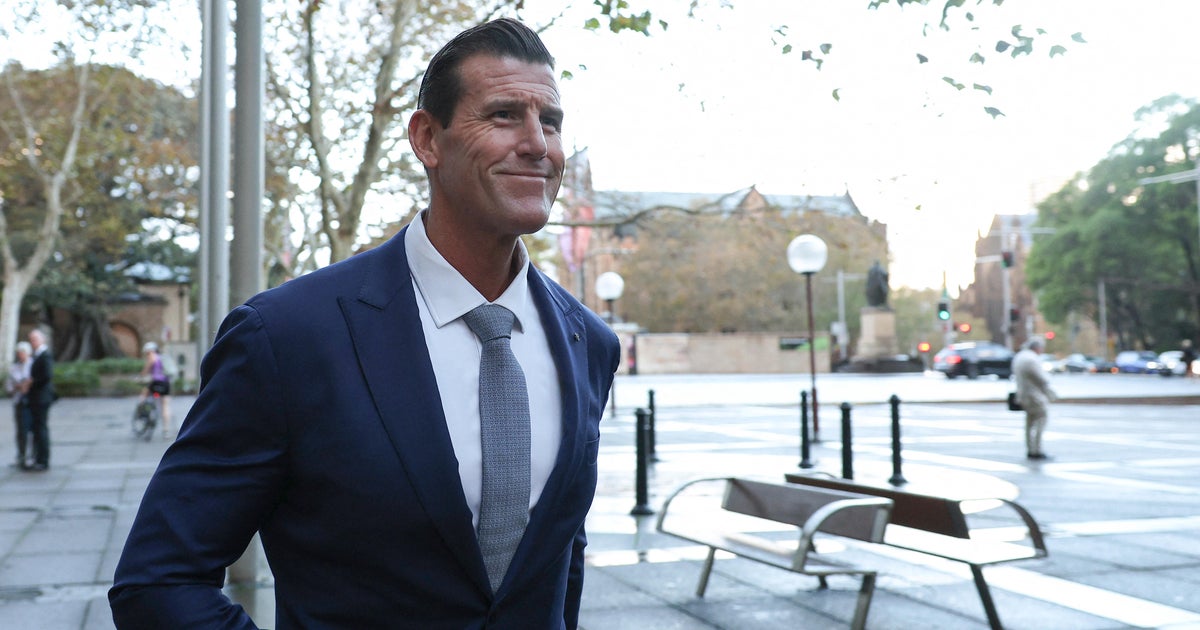

Australia’s Most Decorated War Hero Faces Murder Charges: The Fall of Ben Roberts-Smith
From National Hero to Accused War Criminal
Ben Roberts-Smith, once celebrated as Australia’s most decorated living veteran and a national hero, now finds himself on the other side of justice, facing five counts of war crime murder. The 47-year-old former Special Air Service Regiment corporal was arrested at Sydney Airport on Tuesday after arriving on a flight from Brisbane. Australian Federal Police allege that Roberts-Smith killed five unarmed Afghan civilians during his deployment in Afghanistan between 2009 and 2012. The charges represent a stunning fall from grace for a man who was once honored by Queen Elizabeth II, had his portrait displayed at the Australian War Museum, and was even named Australia’s “Father of the Year.” The arrest marks only the second time an Australian veteran of the Afghanistan campaign has faced war crime charges, signaling a significant moment in Australia’s reckoning with alleged atrocities committed during the 20-year conflict.
The allegations against Roberts-Smith are deeply disturbing and paint a picture of systematic brutality rather than isolated incidents. Police Commissioner Krissy Barrett outlined the nature of the charges, explaining that the victims were allegedly not participating in hostilities at the time of their deaths. “It will be alleged that the victims were detained, unarmed and were under the control of ADF members when they were killed,” Barrett told reporters, referring to the Australian Defense Force. The accusations include claims that Roberts-Smith shot victims himself or ordered subordinate soldiers to carry out the killings in his presence. Among the specific allegations reported by Reuters and Amnesty International are that Roberts-Smith killed an unarmed Afghan teenager, kicked a handcuffed man off a cliff before ordering his execution, and was involved in shooting a wounded man with a prosthetic leg. These are not the actions of combat under duress but alleged deliberate acts against defenseless individuals.
Legal Journey and Court Battles Ahead
Roberts-Smith spent Tuesday night in custody following his arrest and made his first court appearance on Wednesday, where he was expected to apply for bail. War crime murder is a serious federal offense in Australia, defined as the intentional killing of someone not actively participating in hostilities during armed conflict—including civilians, prisoners of war, or wounded soldiers. The charge carries a potential sentence of life imprisonment, reflecting the severity with which international law treats violations of the rules of war. Roberts-Smith becomes only the second Australian Afghanistan veteran to face such charges, following former SAS soldier Oliver Schulz, 44, who has pleaded not guilty to war crime murder for allegedly shooting Afghan man Dad Mohammad three times in the head in May 2012.
What makes Roberts-Smith’s case particularly complex is that he has already faced legal scrutiny over these allegations in civil court. In 2018, several Australian newspapers published articles accusing him of various war crimes, prompting Roberts-Smith to sue for defamation. That decision proved catastrophic for his reputation. In 2023, a federal judge rejected his defamation claims and ruled that he likely killed four noncombatants unlawfully in 2009 and 2012. The judge found that the war crimes allegations were mostly proved on a “balance of probabilities”—the standard of proof required in civil cases. Roberts-Smith attempted to appeal this devastating ruling, but in September, Australia’s High Court declined to hear his case, effectively ending his chances of overturning the decision. However, the new criminal charges represent a higher legal bar: prosecutors must now prove the allegations “beyond reasonable doubt,” the standard required for criminal convictions. This distinction means that while a civil court found the allegations credible, the criminal proceedings will require even stronger evidence.
A Broader Pattern of Alleged War Crimes
The charges against Roberts-Smith didn’t emerge in isolation but are part of a broader investigation into alleged war crimes committed by Australian forces in Afghanistan. The turning point came in 2020 when a military report was released that found evidence elite Australian SAS and commando regiment troops unlawfully killed 39 Afghan prisoners, farmers, and other noncombatants. This shocking report, the result of a four-year inquiry, exposed a culture of impunity and alleged extrajudicial killings within certain units of Australia’s special forces. The findings shook the nation and led to the establishment of the Office of the Special Investigator, created specifically to work with police on investigating war crime allegations arising from the Afghanistan deployment.
According to Ross Barnett, the Office’s director of investigations, allegations of 53 war crimes have been investigated, with 39 of those investigations concluding without charges being filed. This context is important: it demonstrates that not every allegation has led to prosecution, and investigators have been selective about which cases to pursue criminally. Police Commissioner Barrett was careful to emphasize that the alleged criminal conduct involved only a small fraction of Australia’s military personnel. “The alleged conduct related to these charges is confined to a very small section of our trusted and respected ADF which helps keep this country safe,” Barrett said. She stressed that the overwhelming majority of Australian Defense Force members serve with honor and distinction, and that Tuesday’s charges should not reflect on the 40,000 Australian military personnel who served in Afghanistan between 2001 and 2021, of whom 41 were killed in action.
International Implications and Calls for Justice
The arrest has been welcomed by human rights organizations as an important step toward accountability for alleged wartime atrocities. Amnesty International called Roberts-Smith’s arrest a “critical step toward global justice and accountability efforts.” Zaki Haidari, Amnesty International Australia’s strategic campaigner, emphasized that “Australian authorities must now ensure all credible allegations are fully investigated and, where appropriate, prosecuted.” The case has international significance because it demonstrates that even decorated soldiers from Western democracies can face consequences for alleged violations of international humanitarian law. This sends an important message about the universality of war crimes prosecutions and may influence how other nations approach allegations against their own military personnel.
The prosecution of Roberts-Smith also represents a test of Australia’s commitment to the principles of international humanitarian law and the laws of armed conflict. These laws exist to protect those who are not participating in hostilities—civilians, prisoners, and the wounded—even during wartime. When soldiers allegedly violate these fundamental rules, as Roberts-Smith is accused of doing, it undermines the moral authority of military operations and can fuel cycles of violence and revenge. For Afghanistan, a country that has suffered decades of conflict, the prosecution may offer some measure of recognition that the lives of Afghan civilians matter and that their deaths will not be ignored or dismissed simply because they occurred in a war zone far from international attention.
The Spectacular Fall of a National Icon
The contrast between Roberts-Smith’s former status and his current predicament could hardly be more stark. In 2011, he was awarded the Victoria Cross, Australia’s highest military honor, reserved for only the most courageous wartime exploits. He met Queen Elizabeth II at Buckingham Palace, where photographs captured him receiving royal recognition for his service. His portrait was hung at the Australian War Museum, cementing his place in the nation’s military history. He was celebrated not just as a soldier but as a role model, being named Australia’s “Father of the Year”—an honor that now seems bitterly ironic given the allegations he faces. Roberts-Smith became a household name, the kind of military hero that nations rely on to justify the sacrifices of war and to inspire future generations of service members.
Now, that carefully constructed image has been shattered. The man once held up as the embodiment of Australian military virtue stands accused of some of the most serious crimes a soldier can commit: the murder of defenseless, unarmed civilians during wartime. Whether Roberts-Smith is ultimately convicted remains to be seen—he is entitled to the presumption of innocence, and the criminal standard of proof is demanding. However, the civil court’s findings have already done tremendous damage to his reputation, and the criminal charges ensure that his legacy will be forever intertwined with these dark allegations. As he potentially applies for bail and begins the long legal process ahead, Roberts-Smith faces not just the prospect of life imprisonment but the complete destruction of everything he once represented. His case serves as a sobering reminder that the fog of war can obscure terrible acts, but eventually, the truth has a way of emerging, and even the most decorated heroes can fall when allegations of war crimes come to light. The trial will be watched closely, both in Australia and internationally, as a measure of whether justice can be achieved for victims of alleged war crimes, no matter how celebrated the accused may once have been.