

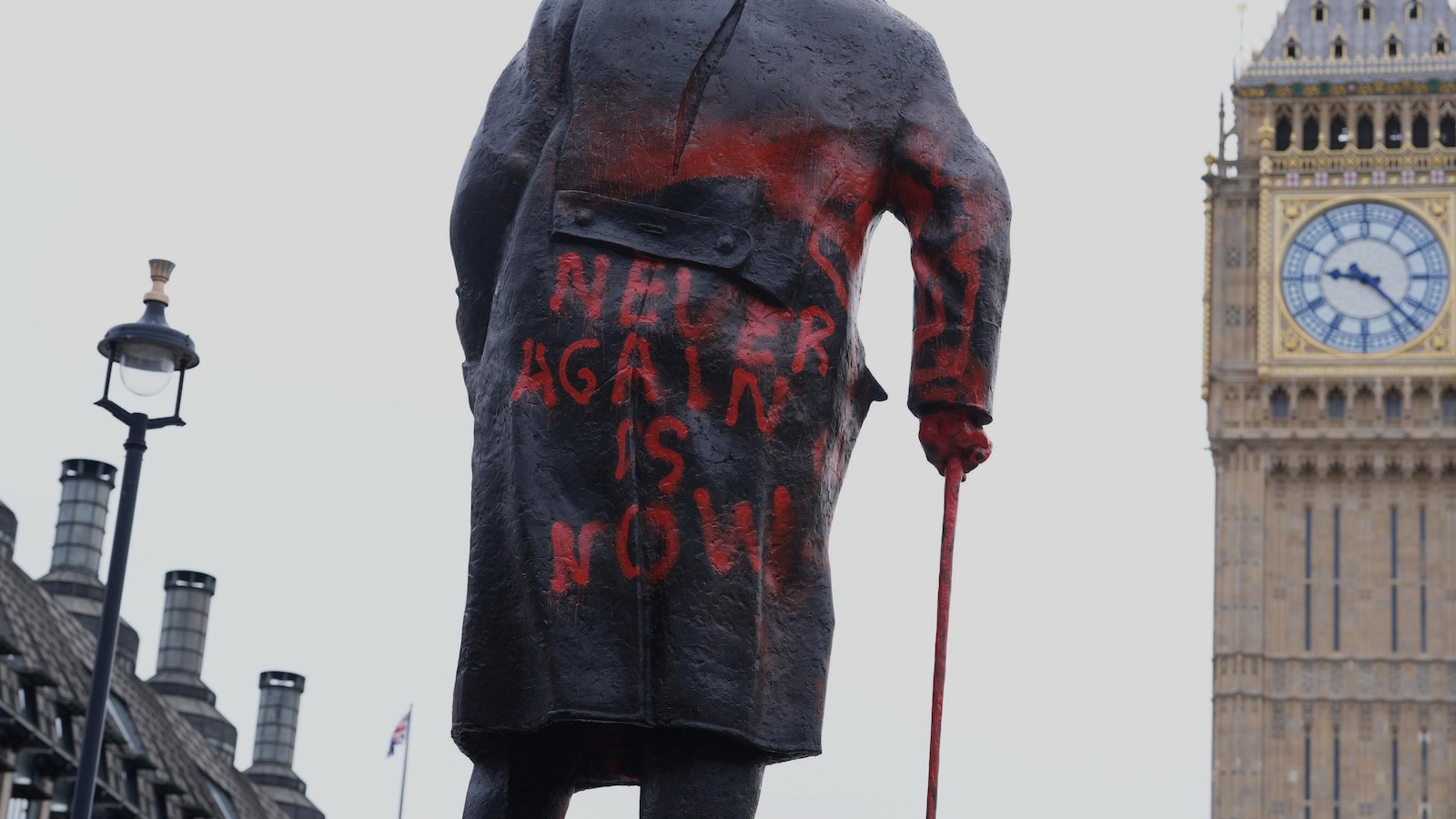

Vandal Paints Pro-Palestinian Message on Winston Churchill Statue in London
Red-Handed Arrest in Heart of British Capital
In a bold act of political protest that has reignited debates about historical figures and modern conflicts, London’s Metropolitan Police apprehended a 38-year-old man on Friday after he allegedly defaced the iconic statue of Winston Churchill in Parliament Square. The suspect was caught, as police put it, “red-handed”—literally covered in the same red paint he had used to scrawl pro-Palestinian messages across one of Britain’s most recognizable monuments. The statue, which depicts Britain’s wartime leader leaning on his walking stick while gazing toward Big Ben and the Houses of Parliament, was vandalized with phrases including “Zionist war criminal” painted directly on its stone plinth, along with “Stop the Genocide” and “Free Palestine” splashed across the bronze sculpture itself. The arrest came on suspicion of racially aggravated criminal damage, reflecting the serious nature with which British authorities view attacks on symbols of national heritage, particularly when they involve language that could incite racial or religious tensions.
The Activist Behind the Action
The individual allegedly responsible for the vandalism didn’t wait long to claim credit for his actions. A man identifying himself as Olax Outis, who stated he is Dutch and associated with an activist collective, took to Instagram with a carefully prepared seven-part series of posts that appeared to have been recorded before the protest took place. In these messages, which he clearly anticipated posting while in police custody, Outis wrote: “If you see this message that peaceful protest has begun and it’s a reasonable assumption that I’m currently in a jail, somewhere in London.” His posts weren’t merely an admission of responsibility but a manifesto of sorts, explaining his motivations and framing his actions within a broader context of what he views as ongoing injustices. The pre-recorded nature of these messages suggests this wasn’t a spontaneous act of vandalism but rather a calculated political statement designed to maximize attention and spark public discourse about the Israeli-Palestinian conflict and Britain’s role in it.
Connection to Broader Activist Movement
The vandalism was claimed by a Dutch organization calling itself “Free the Filton 24,” a name that references two dozen Palestine Action activists who have been charged with breaking into facilities belonging to Elbit, an Israel-based defense company with operations in the United Kingdom. This connection places the Churchill statue defacement within a larger pattern of direct action protests targeting symbols and infrastructure connected to Israel or British support for Israeli policies. Palestine Action has become increasingly visible in the UK, with activists regularly staging protests, occupations, and property damage at sites associated with companies that manufacture weapons or technology used by Israeli defense forces. By naming themselves after arrested comrades, “Free the Filton 24” signals solidarity with those facing legal consequences for similar activism and suggests a coordinated international effort rather than isolated incidents. This network of activists views their actions not as random vandalism but as legitimate political protest against what they perceive as complicity in human rights violations and ongoing violence in Gaza and the occupied Palestinian territories.
Outis’s Justification and Message
In his Instagram statement, Outis didn’t shy away from controversial language or sweeping historical judgments. He specifically denounced both Winston Churchill and the current British government, framing his vandalism as an attempt to draw “attention to the horrible human rights violations happening in a country that’s run by colonizers who refuse to listen to their people.” His choice of Churchill as a target is particularly symbolic—while the wartime prime minister remains a hero to many Britons for his leadership during World War II, he has also faced growing scrutiny in recent years for his views on race, empire, and colonial subjects. Critics have pointed to Churchill’s role in decisions that led to famine in Bengal, his support for the use of chemical weapons against “uncivilized tribes,” and his explicit belief in racial hierarchies. By labeling Churchill a “Zionist war criminal,” Outis connected historical British imperialism with contemporary British foreign policy, suggesting an unbroken line of what he views as oppression and violence. His reference to a government that “refuses to listen to their people” also touches on a genuine tension in British politics, where public opinion polls have shown significant support for Palestinian rights and calls for ceasefire, while government policy has remained broadly supportive of Israel.
A Statue with a Troubled History
The Churchill statue, created by sculptor Ivor Roberts-Jones and unveiled in 1973, has become something of a lightning rod for protesters from various movements, each using the bronze figure as a canvas for their particular grievances. This isn’t the first time red paint has stained its surface, nor is it likely to be the last. During the Black Lives Matter protests that swept across Britain and the world in the summer of 2020, activists spray-painted the word “racist” on the statue’s plinth, prompting heated debates about how societies should memorialize flawed historical figures. That incident led to the statue being temporarily boarded up for protection and sparked fierce arguments between those who wanted to preserve Churchill’s memory untarnished and those who insisted on acknowledging the darker aspects of his legacy. Just months ago, in October, climate activists from Extinction Rebellion targeted the same statue with similar “racist” graffiti as part of their protests connecting environmental destruction with historical and ongoing colonialism. Each defacement generates a predictable cycle: condemnation from government officials and heritage organizations, cleanup operations, renewed security measures, and passionate public debate about freedom of expression, the limits of protest, and how democratic societies should remember complicated historical figures.
Broader Implications and Public Response
The repeated targeting of the Churchill statue reflects deeper tensions in British society about national identity, historical memory, and contemporary political commitments. For some Britons, Churchill remains an almost sacred figure whose leadership during the nation’s “finest hour” should be honored without qualification. For others, particularly younger generations and communities with historical ties to Britain’s former colonies, Churchill represents a more troubling legacy of empire, racism, and violence that deserves critical examination rather than uncritical celebration. The specific connection to the Israeli-Palestinian conflict adds another layer of complexity, touching on Britain’s historical role in the Middle East through the Balfour Declaration and the Palestine Mandate, as well as current foreign policy debates about arms sales, diplomatic support, and human rights. While the Metropolitan Police have the arrested suspect in custody—following standard British practice of not naming individuals before they’re formally charged—the incident has already achieved what Outis and his colleagues likely intended: widespread media coverage and renewed conversation about the issues they’re highlighting. Whether these tactics ultimately advance their cause or create backlash remains an open question, but the willingness of activists to risk arrest for symbolic protest actions suggests the depth of feeling around these issues and the frustration some feel with conventional political channels. As cleanup crews once again scrub red paint from bronze and stone, the fundamental questions raised by this act of vandalism—about historical accountability, contemporary justice, and the proper forms of political expression—will linger long after the statue is restored.