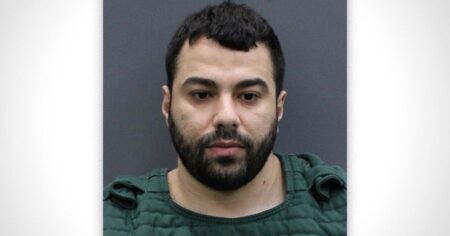




A 13-Year Journey to Justice: The Tragic Death of Heidi Firkus
The Night That Changed Everything
In the predawn hours of April 25, 2010, a desperate 911 call shattered the quiet of a St. Paul, Minnesota neighborhood. Twenty-five-year-old Heidi Firkus frantically reported to dispatchers that someone was trying to break into her home. The terror in her voice was palpable as she pleaded for help, but the call ended suddenly with a jarring noise that would mark the beginning of a mystery that would take over a decade to solve. Just over a minute later, another call came through—this time from Heidi’s husband, Nick Firkus, 27, screaming that his wife had been shot and that he too had been wounded. When first responders arrived at the scene, they found a nightmare: Nick had sustained a gunshot wound to his thigh, while Heidi had been shot in the upper back and was unresponsive. Despite all efforts, Heidi died at the scene, leaving behind devastated family members and a community searching for answers. What initially appeared to be a home invasion gone horribly wrong would eventually reveal itself to be something far more sinister—a carefully constructed lie that would unravel over thirteen painstaking years of investigation.
A Story Full of Holes
Nick Firkus presented investigators with what seemed like a straightforward account of a burglary turned deadly. He told police that he had awakened to suspicious sounds at the front door in the middle of the night. Acting to protect his family, he grabbed his shotgun and alerted his sleeping wife to the danger. According to Nick’s version of events, a violent struggle ensued with an intruder at their front door, during which the shotgun discharged twice—once striking Heidi and once hitting him in the leg. He described the intruder as possibly being a Black male, though he admitted he wasn’t entirely certain. However, from the very beginning, something didn’t sit right with the investigating officers, particularly Sergeant Jim Gray of the St. Paul Police Department. The Firkus house was clean and orderly, with no signs of the chaos one would expect from a violent home invasion. The entryway table beside the front door remained perfectly undisturbed, as if no struggle had taken place there at all. Despite extensive neighborhood canvassing and a thorough K9 search of the area, investigators found absolutely no sign of an intruder—no footprints, no disturbances in the yard, no witnesses who had seen anyone fleeing the scene. The physical evidence simply didn’t support Nick’s dramatic story of a life-or-death battle with a burglar.
Financial Secrets and Hidden Troubles
As investigators dug deeper into the couple’s life, they uncovered troubling information that Nick had failed to mention initially. The Firkuses were drowning in over $15,000 of credit card debt, and more significantly, they were on the verge of losing their home. What made this discovery even more disturbing was that none of their friends or family members knew about their dire financial situation. Most shockingly, the couple was scheduled to be evicted the very next day—just hours after Heidi’s death. When police searched the home, they found no evidence that the couple had been preparing to move. There were no packed boxes, no signs of sorting belongings, nothing that would indicate an imminent departure from the house. Commander Jake Peterson noted that the home didn’t look like anyone was planning even a long vacation, much less a permanent move. This raised a chilling question: Did Heidi even know about the eviction? Investigators reviewed correspondence between the couple and examined financial documents found in the home, but they could find no proof that Heidi Firkus had any knowledge of the impending eviction. The evidence suggested that Nick had been keeping devastating secrets from his wife, hiding the extent of their financial troubles and the looming crisis they faced. When Sergeant Gray directly asked Nick if he had anything to do with his wife’s murder, Nick firmly denied it, saying “Absolutely not.” However, upon retaining defense attorney Joe Friedberg, Nick ceased all cooperation with the police investigation and declined their request to work with a sketch artist to create a composite of the alleged intruder.
A Second Marriage and Disturbing Patterns
Just a few months after Heidi’s death, Nick met Rachel Watson, and the two began dating. Rachel felt sympathy for Nick, believing he had survived a traumatic experience that had claimed his wife’s life. After a year of courtship, they married in August 2012 and went on to have three children together. Nick’s parents purchased a house for the new family, with an arrangement that Nick and Rachel would pay the mortgage amount to his parents while Nick handled the property taxes directly with the county. For several years, their life seemed normal, but then Rachel made a disturbing discovery. She found a notice in their home stating that they were delinquent on their property taxes and that their house was in danger of being foreclosed. The revelation hit Rachel like a lightning bolt—her mind immediately went to Heidi’s death and the financial troubles that had preceded it. The parallels were too striking to ignore. Rachel realized that once again, Nick had been hiding serious financial problems from his spouse, lying repeatedly while maintaining the appearance that everything was fine. The realization that she didn’t know this was happening and was living with someone who could so easily deceive her, especially given what had happened the last time he faced financial difficulties, terrified her. Rachel decided to confront Nick about the situation, and in a moment that showed remarkable courage and foresight, she recorded their conversations. In one particularly chilling exchange, Rachel said to Nick, “The fact that your lying was so easy for you to do in front of me over and over and over makes me think…” Nick interrupted, asking, “That I could murder my wife?” Rachel’s simple response was “Yes.” The couple divorced in 2018, and Rachel’s experience would later prove crucial to finally bringing justice for Heidi.
New Technology, Old Evidence, and a Break in the Case
In 2019, nearly a decade after Heidi’s death, Sergeant Nichole Sipes of the St. Paul Police Department decided to take a fresh look at the cold case. Something about the circumstances had always bothered her—the pieces just didn’t fit together in a way that supported Nick’s story. Sipes reached out to the FBI to utilize new technology that could reconstruct sound data from the original 911 calls to determine if there was any evidence of a third person in the house during the shooting. The results were damning: “There was no noise that we could detect in the background,” FBI Agent Pat Reilly reported. The FBI also conducted ballistics testing and created a virtual model of the Firkus house to analyze the trajectory and circumstances of the shots. Their findings suggested that the shots were most likely not “accidental” discharges during a struggle, as Nick had claimed, but rather deliberate and intentional. When Sipes learned of Nick’s divorce from Rachel, she reached out to his ex-wife, who shared her suspicions about the financial deceptions and the disturbing pattern she had witnessed. Sipes recognized that Rachel herself could have become another victim if she hadn’t discovered the truth and gotten out of the marriage. Armed with new forensic evidence, witness testimony, and a clearer picture of Nick’s pattern of deception, prosecutors finally felt they had enough to move forward. In May 2021, more than eleven years after Heidi’s death, Nick was arrested and charged with second-degree murder. A grand jury later elevated the charge to first-degree murder, and the case that had haunted investigators for over a decade was finally heading to trial.
Justice Delayed but Not Denied
When the case finally went to trial, Ramsey County prosecutors painted a picture of a man trapped by his own lies and willing to commit the ultimate crime to avoid facing the consequences of his deceptions. Assistant District Attorney Elizabeth Lamin argued that Nick had hidden the details of their financial troubles from Heidi and murdered her because he couldn’t face the shame of their impending eviction. “It wasn’t just going to be the loss of this house, it was going to be the realization that he had lied to his wife, and he had lied to his friends, he had lied to the community for many years,” Lamin told investigators. The prosecution presented compelling evidence: only Nick’s DNA was found on the gun, multiple witnesses testified that there were no signs of a break-in, the 911 call contained no evidence of a third person, and the ballistics evidence contradicted his story of an accidental shooting during a struggle. Nick’s defense attorneys, including Robert Richman, attempted to refute these allegations, arguing that an intruder wearing gloves who was only in the home for seconds couldn’t have left DNA evidence, and that the forensic findings didn’t necessarily disprove Nick’s version of events. On February 10, 2023, after four hours of deliberation, the jury found Nick Firkus guilty of murder. That April, he was sentenced to life in prison without the possibility of parole—the maximum sentence for his crime. Nick’s family, while declining an interview request from ABC News, issued a statement maintaining his innocence: “He was wrongfully convicted and sits in jail for a crime he did not commit. This is not just the belief of heartbroken parents.” However, in February 2026, the Minnesota Supreme Court upheld Nick’s convictions, affirming that justice had been properly served. After thirteen long years, Heidi Firkus’s family finally had the answers and closure they had been seeking, though it could never bring back the young woman whose life was cut tragically short by someone she trusted most.